Israel’s Prime Minister Benjamin Netanyahu recently announced that progress towards a second phase of the US-brokered peace plan for Gaza is imminent, although he acknowledged that several critical issues remain unresolved. The second phase of the initiative, originally proposed by former President Donald Trump, calls for a further withdrawal of Israeli troops from Gaza, the establishment of a transitional authority, and the deployment of an international security force. Key to this plan is the disarmament of Hamas and the subsequent commencement of reconstruction efforts in the region.
In a sign of potential compromise, a senior Hamas official indicated that the group may be open to discussions about “freezing or storing” its remaining weapons, a pivotal aspect of the negotiations. The US and other mediators are reportedly intensifying their efforts to facilitate the advancement of Trump’s plan amid ongoing hostilities.
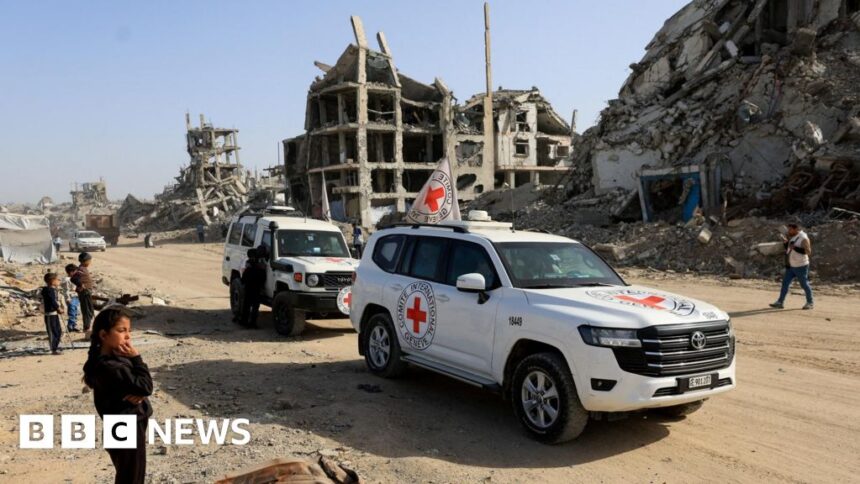
Meanwhile, searches continue for the remains of Sergeant Ran Gvili, an Israeli police officer killed during the Hamas-led attacks on October 7, 2023. A team from the Red Cross, along with members of Hamas’s armed wing, is active in the Zeitoun area of Gaza City, in pursuit of Gvili’s remains, which are to be returned in accordance with the initial ceasefire agreement between the two factions. Netanyahu reassured members of the press, stating, “We’ll get him out.”
Despite the ceasefire being in effect for two months, both sides have leveled accusations against one another for frequent violations. Israeli forces continue to control over half of the Gaza Strip, while Hamas has managed to re-establish its position in the remaining areas.
During a recent press conference, Netanyahu revealed that he would be holding significant discussions with President Trump at the end of the month to strategize on the implementation of the second stage of the peace plan. An Israeli government spokesperson confirmed that this meeting is scheduled for December 29.
In a meeting with German Chancellor Friedrich Merz in Jerusalem, Netanyahu reiterated the necessity of ending Hamas’s control over Gaza and insisted that the armed group must adhere to its commitment to disarmament and demilitarization. When addressing Israeli diplomats later, he expressed skepticism regarding the effectiveness of a proposed multinational force to disarm Hamas. “Now there is a question here: our friends in America want to try to establish an international force that will do the job. I said – please. Are there volunteers here?” Netanyahu queried, highlighting doubts about foreign troops’ willingness to confront Hamas directly.
Emphasizing Israel’s commitment to achieving disarmament one way or another, he asserted, “It can be done the easy way, it can be done the hard way. But eventually it will be done.”
In a conversation with the Associated Press, Hamas official Bassem Naim suggested that the group might be amenable to a broader dialogue on weapon storage as a step to mitigate further violence. He expressed, “We are open to have a comprehensive approach in order to avoid further escalations or in order to avoid any further clashes or explosions.” However, he also criticized Israel for failing to meet key pledges from the ceasefire agreement, including the adequate provision of humanitarian aid and the reopening of the Rafah border crossing with Egypt.
While humanitarian organizations have reported an increase in aid reaching Gaza, they continue to face significant Israeli restrictions. Recently, Israel proposed reopening the Rafah crossing, but only for the exit of individuals, a suggestion that was not accepted by Egypt or the Palestinians, who argued that Israel has an obligation to open the crossing in both directions.
The ceasefire, established after a two-year offensive against Gaza triggered by Hamas’s deadly attacks and mass hostage-taking in southern Israel, has seen the return of 20 living hostages and the remains of 28 deceased individuals in Gaza. In exchange, Israel released nearly 2,000 Palestinian detainees. For each Israeli hostage returned, Israel has also returned 15 Palestinian bodies.
Accusations have arisen from Israel alleging that Hamas is delaying the return of the deceased hostages. The Hamas-run health ministry has reported that over 370 Palestinians have been killed by Israeli fire since the ceasefire went into effect, with Israel maintaining that its military actions are in response to violations, including incursions by individuals into Israeli-held areas of Gaza. The conflict has also resulted in the deaths of three Israeli soldiers amid ongoing skirmishes, with numerous Hamas operatives reported to be entrenched in underground tunnels in southern Gaza.
Last week, Trump conveyed optimism regarding the advancement of the second phase of the Gaza plan, suggesting it was “going to happen pretty soon,” while Qatar’s Prime Minister Sheikh Mohammed bin Abdul Rahman Al Thani stated that the situation had reached a “critical moment.”