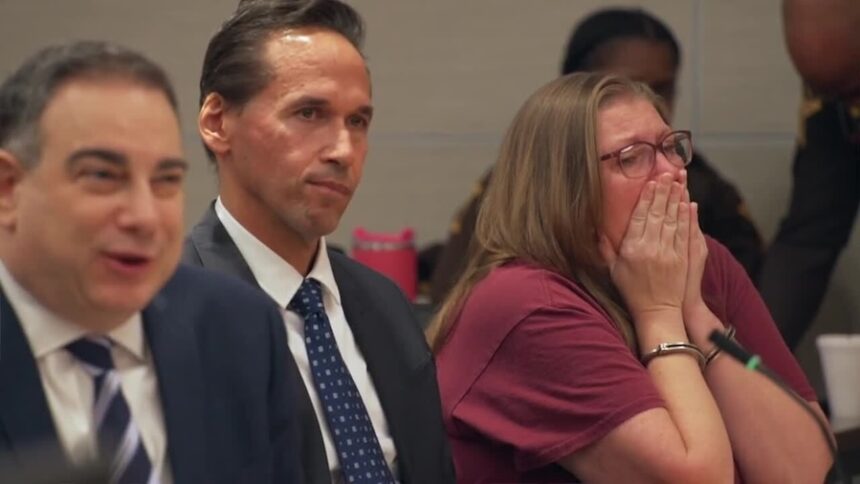
An Indiana woman with a lengthy prison sentence is seeking to modify her penalty two decades after her conviction for murder. Sarah Pender, who was sentenced to 110 years in prison for her involvement in the 2000 killings of her roommates, recently appeared in a Marion County courtroom to present her case for early release. In her petition, Pender expressed remorse for her actions while emphasizing the substantial time she has already served—25 years, including five years in solitary confinement.
Pender pleaded for mercy, stating, “I am asking for a chance to be free and not die in prison.” The tragic events leading to her conviction involved the murders of Andrew Cataldi and Tricia Nordman, whose bodies were discovered in a dumpster. Investigators used tattoos and witness accounts to identify the victims, both of whom were reportedly fugitives.
During the trial, prosecutors portrayed Pender as the mastermind behind the crimes, although her ex-boyfriend Richard Hull claimed sole responsibility for the shootings. Pender acknowledged her wrongdoing but expressed shock at the severity of her sentence. “I bought the gun. I didn’t run away and report the crime, and I helped Rick afterward. I deserved to go to jail,” she noted, clarifying her role despite being labeled as a manipulator akin to notorious figures like Charles Manson.
At the time of her sentencing, Pender received 45 years for each murder, totaling 110 years, a sentence she described as “unfathomable.” In 2008, she made headlines when she escaped from the Rockville Correctional Facility through a romantic relationship with a correctional officer. Her escape lasted four months before she was recaptured in Chicago, which she later described with a mix of regret and acceptance of her circumstances.
Former Marion County Prosecutor Larry Sells, who initially advocated for Pender’s severe sentence, has since publicly criticized it as excessive and unjust, stating that her role in the crime was not as significant as once thought. His support for Pender’s release is seen as a dramatic shift in narrative, described as “virtually unprecedented.”
Pender’s current attorney cited her age at the time of the crime—21 years—as a possible mitigating factor for her release, arguing that she has fundamentally changed during her time in prison. The prospect of her release hinges on the pending decision of the judge, who is considering the petition and is expected to rule within 30 days.
Pender’s family is optimistic about her potential release, with plans in place for her to relocate to Arizona should the judge grant her request. Her mother expressed the dream for her daughter to experience life outside prison walls, envisioning a home filled with love and support.
Despite her family’s hopes, relatives of the victims remain opposed to any modification of Pender’s sentence. In a heartfelt statement, Pender acknowledged their suffering, saying, “I am so sorry for the terrible loss that you suffered and for the role I played in it.”
As the court deliberation continues, Pender remains hopeful for a decision that could lead to her freedom, ideally before Christmas. Her father expressed a mixture of optimism and uncertainty about the outcome, emphasizing the importance of hope in navigating the future.