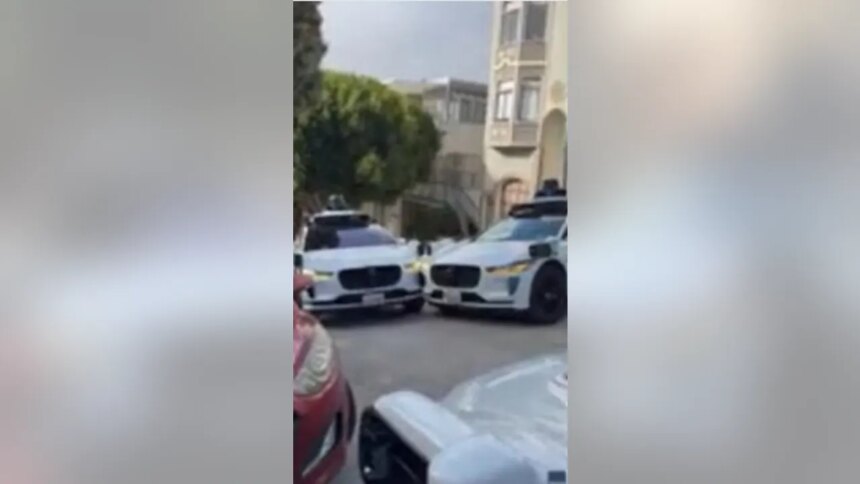
A recent incident involving a group of driverless Waymo cars in San Francisco has sparked significant attention on social media, leading to discussions about the challenges posed by autonomous vehicles on urban traffic. The event, which took place on December 6, was captured by TikTok user @chii_rinna and has since garnered over 3 million views.
In the video, the user humorously describes the scene as a “Waymo standoff,” highlighting how the autonomous vehicles created a traffic jam while seemingly trying to navigate a dead-end street. A nearby resident, frustrated and looking to exit his garage, adds to the comedic nature of the situation by expressing his exasperation at being “stuck” behind the Waymos. The amusing commentary and unexpected complications of the standoff caught the attention of many viewers, leading to widespread shares and commentary online.
Waymo has since responded to the incident, explaining that two of its cars made “minor contact at low speed” while attempting a multi-point turn. The company acknowledged the situation and indicated that they are investigating further, emphasizing their commitment to learning from such occurrences to enhance their technology. In addition to this incident, residents in the South of Market (SoMa) neighborhood have expressed ongoing frustrations with traffic interruptions caused by autonomous vehicles. On the same day as the standoff, Waymo cars reportedly blocked streets and created bottlenecks, with one vehicle struggling to enter a garage confusing drivers in both directions.
Local resident Guillermo Paletto voiced his concerns, noting that the driverless cars often create significant delays during critical moments, such as emergencies. He mentioned a recent case where a passenger in a Waymo experienced a medical emergency, leading to the birth of a child en route to the hospital. Although the company stated that the technology responded appropriately by contacting emergency services, the incident raised questions about the reliability of autonomous vehicles in urgent situations.
Experts in the field of autonomous technology acknowledged that high-profile incidents like these are somewhat expected as self-driving features are integrated into complex driving environments. Billy Riggs, an expert from San Francisco State University, pointed out that while these incidents attract attention due to their novelty, they also serve as important learning experiences for the companies behind the technology. He highlighted that without the instinct-driven decisions typical of human drivers, autonomous vehicles generally operate in a more disciplined and less distracted manner.
In contrast, first responders in the city have emphasized the need for continuous adaptation in their approach to incidents involving self-driving cars. Firefighters and other emergency personnel are actively evolving their strategies, maintaining direct communication lines with autonomous vehicle companies for emergencies. This ensures that, if necessary, operators can take control of their vehicles remotely to assist in urgent scenarios.
The dialogue surrounding this incident and others like it raises pertinent questions about the integration of self-driving technology in urban landscapes, balancing innovation with public safety and efficiency.