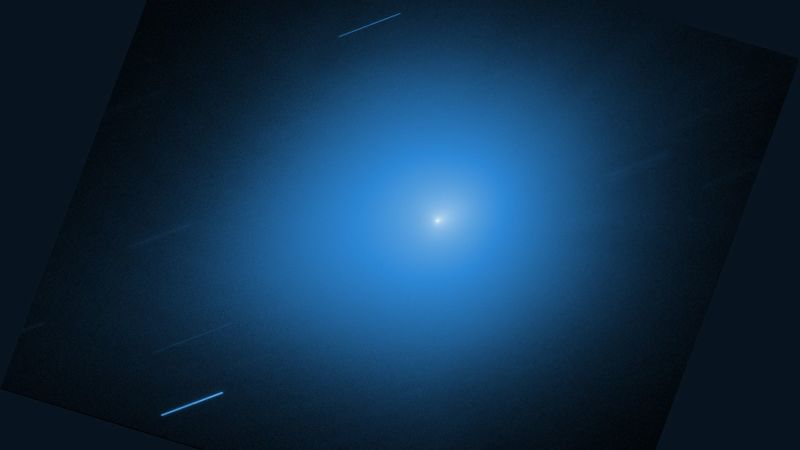
Fresh images of the interstellar comet 3I/ATLAS have been captured by both the Hubble Space Telescope and the European Space Agency’s Jupiter Icy Moons Explorer (Juice), as the cosmic traveler approaches its closest point to Earth later this month. Discovered in July, 3I/ATLAS has captivated astronomers due to its origins outside our solar system, marking it as only the third interstellar object ever recorded within our celestial neighborhood.
Astronomers have been keenly focused on 3I/ATLAS, directing multiple observational missions to gather insight into its trajectory and composition. Observations taken during its recent close encounter with the sun in October have yielded critical information regarding the gases that sublimated from its surface, further enhancing our understanding of this unique comet.
Hubble, one of the telescope’s first observers of 3I/ATLAS shortly after its discovery, provided an early detailed image that illustrated the comet’s teardrop shape. On November 30, Hubble captured another more refined image of the comet when it was approximately 178 million miles (286 million kilometers) away from Earth, utilizing the telescope’s Wide Field Camera 3.
Simultaneously, the Juice mission, which was launched in April 2023 and is en route to study Jupiter and its icy moons, observed the comet from a distance of about 41 million miles (66 million kilometers) at the beginning of November. Juice employed five scientific instruments along with its onboard Navigation Camera (NavCam) to examine the comet. Due to limitations in data transmission, most of the detailed information won’t reach Earth until February, as the main antenna is being utilized as a heat shield against the sun.
In an effort to expedite findings, the Juice team has downloaded a quarter of an image captured by NavCam, revealing significant activity around the comet, including a glowing halo of gas known as a coma, as well as two distinct tails: a plasma tail of electrically charged gas and a faint dust tail composed of solid particles being released from the comet.
Typically, comets originating from the solar system feature similar characteristics, consisting of a hazy coma surrounding a solid core of rock, gas, and ice remnants from the formation of celestial bodies. As they approach stars, the increased heat causes the release of sublimating materials that form distinct tails trailing behind them.
Comet 3I/ATLAS is projected to come within 167 million miles (270 million kilometers) of Earth on December 19, though its position will be on the opposite side of the sun, posing no risk to our planet. For context, Earth is located about 93 million miles (150 million kilometers) from the sun. After its close pass, the comet will remain visible to telescopes and space missions for several months before continuing its journey out of our solar system.
Further data from Juice’s flyby, expected between February 18 and 20, is anticipated to include images from the spacecraft’s high-resolution optical camera, alongside composition and particle analyses that could shed light on the comet’s origins and the materials it carries.