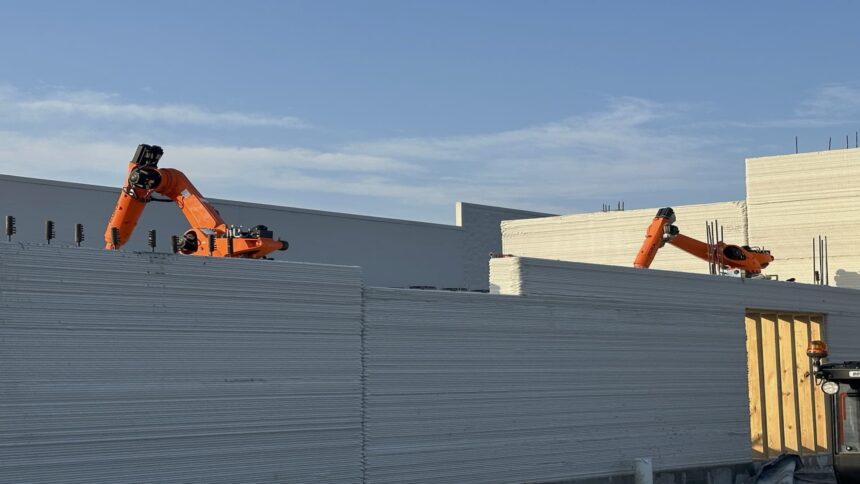
In a significant advancement for commercial real estate, Walmart has collaborated with Alquist 3D to construct a nearly 8,000-square-foot addition to its Athens, Tennessee store. This remarkable addition is noted as the largest 3D-printed commercial structure in the United States, despite initial challenges. Serving as a hub for online order pickup and delivery services, this project is seen as a pivotal proof of concept for the feasibility of 3D printing technology in commercial construction.
The deal marks a substantial expansion for Alquist, which is based in Greeley, Colorado. The company has announced plans to print more than a dozen additional buildings for Walmart and other commercial retailers. This initiative is heralded as the largest deployment of 3D printing technology in the commercial sector, a field that has been traditionally slower to adopt such innovations compared to residential construction.
Key to Alquist’s strategy is its partnership with Sika, a renowned global construction materials company emphasizing sustainability. Sika will supply Alquist with materials for all its future 3D-printed projects, streamlining the supply chain, reducing costs, and enhancing the development of sustainable mixes tailored for large-scale printing.
“This collaboration positions Sika at the forefront of next-generation construction,” stated Noah Callantine, a 3D concrete printing engineer with Sika, highlighting the long-term growth opportunities presented by this partnership.
Alquist’s venture into commercial construction comes at a time when the industry is grappling with the need for modernization. While 3D printing has made some inroads in residential building, commercial applications have lagged due to the size and complexity of the required printers. However, Alquist has been addressing these challenges, successfully creating larger-scale printers and developing the necessary operational software.
Patrick Callahan, the CEO of Alquist, emphasized the importance of scaling technology to drive down costs. “The way to bring prices down is to get volume,” he said, explaining that increased demand attracts suppliers’ attention and leads to lower costs.
While Callahan acknowledges that the first project in Athens faced obstacles, he reports substantial improvement in subsequent projects. The second addition, a 5,000-square-foot Walmart pickup center in Huntsville, Alabama, was completed in just seven days, demonstrating the efficiency gained from lessons learned.
To operate these advanced technologies, Alquist requires workers with specialized training. The company collaborates with trade schools to develop a curriculum that incorporates robotics and sustainable materials, thus attracting talent in an increasingly competitive labor market. “We’ve seen a lot of traditional construction workers who pushed back begin to lean in,” Callahan noted.
Amidst this changing landscape, competition is also emerging in the realm of commercial 3D printing. Icon Build, a leading residential 3D printing firm, is venturing into commercial projects, having completed a hotel and engaging with potential partners for data center constructions. The company’s forthcoming Titan printer is expected to facilitate larger-scale projects and is anticipated to significantly impact the construction market.
Jason Ballard, co-founder and CEO of Icon, foresees substantial growth with their new printer. He expressed optimism about showcasing its capabilities, which would potentially lead to increased interest in alternative construction methods across various sectors, including commercial sales.
However, Ballard also acknowledges the challenges posed by labor shortages in the market, as data centers increasingly consume available resources. The pressures for 3D printing in commercial settings mirror those faced in residential construction: the need for efficiency and cost-effectiveness compared to traditional methods.
Despite these hurdles, Ballard projects that next year will see a robust scale-up in production, with plans to manufacture at least one Titan printer monthly. This scaling effort could lead to a 300% growth in revenue, reflecting the rising recognition of opportunities within this innovative construction space.
As both Alquist and Icon navigate their paths in commercial construction, the future appears bright yet challenging, signaling a pivotal moment in the evolution of building practices and the integration of technology in the industry.