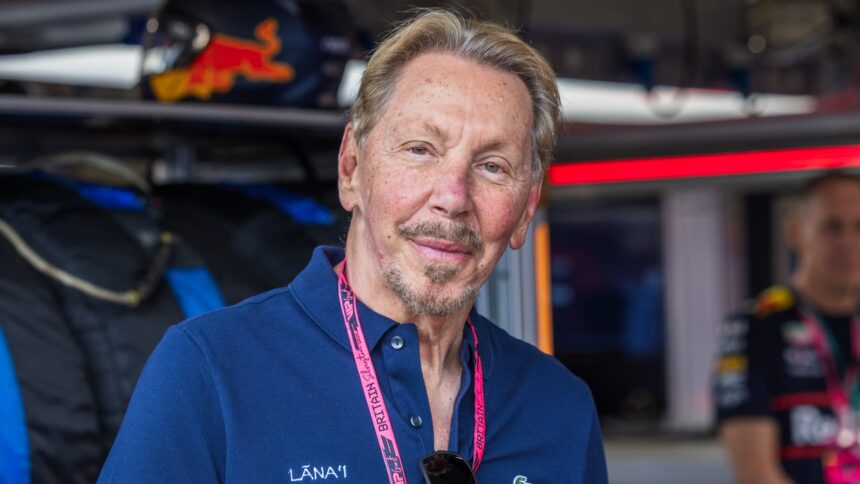
Larry Ellison, co-founder and chief technology officer of Oracle, made a public appearance recently at the Formula One British Grand Prix, highlighting his ongoing visibility in both tech and public arenas. Meanwhile, Oracle is preparing to unveil its fiscal second-quarter results this Wednesday after the market closes, with analysts keenly monitoring the outcomes.
According to estimates compiled by LSEG, analysts expect Oracle to report an adjusted earnings per share of $1.64 and revenue of approximately $16.21 billion. This projection marks a significant 15% increase from $14.1 billion reported in the same quarter a year prior. Specifically, specialists polled by StreetAccount anticipate cloud revenue to hit about $7.92 billion, while software revenue is expected to contribute around $6.06 billion.
The upcoming earnings report arrives at a pivotal juncture for Oracle, which has been ardently positioning itself in the thriving field of artificial intelligence (AI). The company is heavily investing in infrastructure to capitalize on AI advancements, a strategy that has boosted both revenue and order backlogs. However, this aggressive growth has raised concerns among investors regarding the escalating debt burden Oracle is taking on in pursuit of these ambitious AI endeavors.
The company faced a steep decline in its stock, plummeting 23% in November—marking its most challenging month since 2001—and is currently trading 33% below its historic peak recorded in September. Despite this downturn, Oracle shares have seen an impressive 33% increase year-to-date, outperforming the Nasdaq, which has grown 22% over the same period.
Over the last decade, Oracle’s business model has significantly evolved beyond traditional databases and enterprise software, venturing into cloud infrastructure. This space is becoming increasingly competitive, with major tech players such as Amazon, Microsoft, and Google all vying for AI contracts and heavily investing in the requisite data centers and hardware.
OpenAI has notably committed over $300 billion to leverage Oracle’s infrastructure services over the next five years, following its launch of the widely acclaimed ChatGPT three years ago. Larry Ellison emphasized the critical role of Oracle in this ecosystem, stating, “Oracle’s job is not to imagine gigawatt-scale data centers. Oracle’s job is to build them.”
During the recent reporting period, Oracle raised a remarkable $18 billion, one of the largest debt issuances recorded for a technology firm. This has led to heightened skepticism among investors, who have begun purchasing five-year credit default swaps—essentially insurance policies against debt repayment risks—which have surged to multi-year highs. RBC analyst Rishi Jaluria underlined the critical issues of customer concentration and questioned the company’s strategy for managing its escalating debt.
In a significant leadership change, Oracle appointed Clay Magouyrk and Mike Sicilia as new CEOs, taking over from longtime CEO Safra Catz. The company has also unveiled AI agents intended to automate various business operations across finance, human resources, and sales.
Following the earnings announcement, Oracle executives are set to discuss the results and provide guidance in a conference call later in the evening. Concerns about the company’s debt load and its future in the competitive landscape loom large, as investors anticipate insights from this pivotal financial disclosure.