In a significant legislative move, the House of Representatives on Wednesday approved a sweeping $900 billion defense policy bill, setting the stage for a final vote in both chambers before the year’s end. This substantial legislation outlines key defense priorities and authorizes budget allocations for various Defense Department initiatives and national security programs. The measure cleared the House with a robust bipartisan vote, tallying 312 in favor and 112 against.
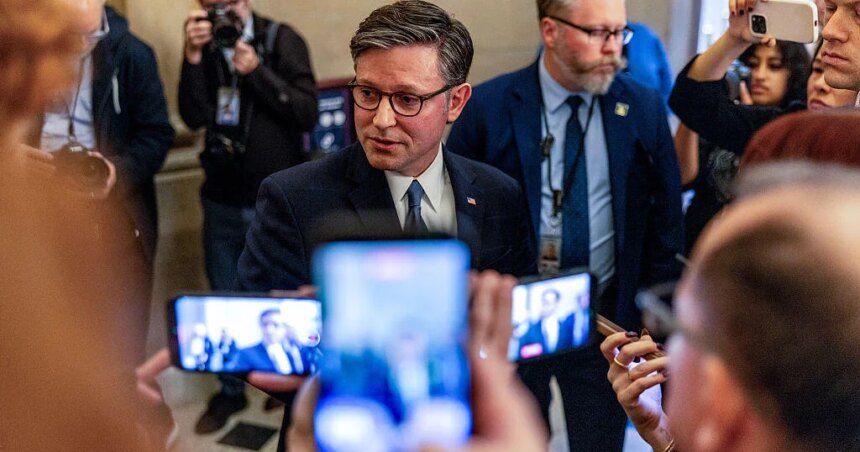
The final hours leading to the bill’s passage were marked by political maneuvering as House Speaker Mike Johnson navigated tensions within his party. A procedural vote, initially projected to last five minutes, extended into an hour as a faction of conservative lawmakers resisted advancing the bill, while some moderates withheld their support altogether. Ultimately, after securing assurances on various issues, these dissenters relented, allowing the bill to proceed.
The text of the newly unveiled 3,086-page compromise bill earmarks significant funding allocations, including $291 billion for operations and maintenance, $234 billion for military personnel and healthcare, $162 billion for procurement, and $146 billion for research and development. Additional provisions authorize $54 billion for military construction and nuclear programs.
The backdrop to this legislative effort included internal disagreements among GOP members. Notably, Rep. Elise Stefanik of New York confronted Speaker Johnson over accusations of obstructing a measure that would require the FBI to notify Congress when opening counterintelligence investigations into federal office candidates. Following public criticism, this provision was integrated into the final bill. The legislation also faced scrutiny from Democrats, particularly after the removal of a provision aimed at expanding IVF coverage for military families.
The defense bill reflects a desire to institutionalize many of former President Donald Trump’s executive orders, including authorizing the deployment of active-duty troops to the U.S.-Mexico border and implementing protective measures against missile attacks. Service members are set to receive a 3.8% pay increase under the new measures.
Additionally, the legislation outlines a contentious ban on transgender women from competing in women’s athletic programs at military service academies, an issue that has garnered significant attention in recent years. While some conservatives have hesitated regarding military aid to Ukraine, the bill designates $400 million for Ukraine’s military assistance over the fiscal years 2026 and 2027.
A particularly notable inclusion in the bill is a stipulation that would withhold a portion of Defense Secretary Pete Hegseth’s travel budget until the Pentagon provides video footage related to strikes on alleged drug-smuggling boats in Venezuela. This provision essentially challenges the administration to release unedited video of operations conducted against designated terrorist organizations in the U.S. Southern Command’s area of responsibility.
The legislation also seeks to revoke the legal justifications for military action in Iraq, both for the 1991 Gulf War and the 2003 invasion. This aligns with growing bipartisan sentiment that the existing authorizations empower presidents to engage in military action without sufficient oversight. Senators from both parties have framed this repeal as an essential step to “close the book” on past conflicts.
In a related measure, the bill eliminates sanctions against Syria established under the Caesar Syria Civilian Protection Act of 2019, and it includes stipulations aimed at restricting the administration’s authority to reduce troop levels in Europe. As the clock ticks down to the end of the year, this defense policy bill stands as a critical focal point of ongoing political negotiations in Congress.