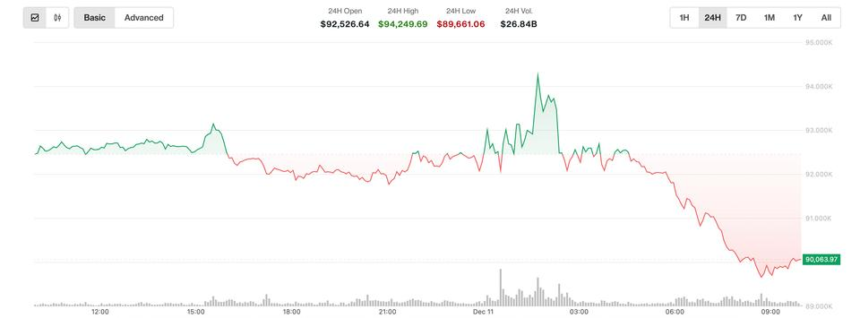
The leading cryptocurrency, Bitcoin, which is currently priced at $90,326.39, has experienced a notable decline following the Federal Reserve’s overnight decision to cut interest rates. The primary factor contributing to Bitcoin’s downturn appears to be the Fed’s messaging that has dampened trader enthusiasm regarding potential future easings.
The Fed announced a reduction in the benchmark interest rate by 25 basis points to 3.25% on Wednesday, in line with widespread expectations. Additionally, it revealed plans to commence purchases of short-term Treasury bills to manage liquidity within the banking system. Despite this, Bitcoin traded below the $90,000 mark during press time, reflecting a 2.4% decrease since the early Asian trading hours, as indicated by CoinDesk data. Ether also saw a decline of 4%, trading at $3,190, while the CoinDesk 20 Index fell by over 4%.
Market sentiment has shifted towards a risk-off attitude, a response likely fueled by emerging signs of discord within the Fed regarding the balance between controlling inflation and pursuing employment goals. Two members of the Federal Open Market Committee (FOMC) voted against the rate change, and forecasts revealed that six members considered a rate cut as “inappropriate.” Furthermore, the central bank signaled only one additional rate cut expected in 2026, causing disappointment among those anticipating two to three cuts.
Greg Magadini, director of derivatives at Amberdata, highlighted the prevailing uncertainty in the market concerning the future trajectory of interest rates, particularly with Chairman Jerome Powell set to be replaced in May 2026. Magadini suggested that until that transition occurs, the market might need to undergo a “deleveraging” phase or experience a downturn to prompt the Fed towards a more decisive stance on rate cuts.
Shiliang Tang, managing partner at Monarq Asset Management, pointed out that Bitcoin is paralleling the stock market’s decline. After an initial spike following the Fed’s announcement, the cryptocurrency market has steadily retreated, coinciding with the downturn in stock market futures. Bitcoin has struggled to surpass the local high of $94,000 for the third time in two weeks. Tang noted a drop in implied volatility, indicating that the significant market catalysts for the year may now be behind us.
Amid discussions of the Fed’s reserve management strategies, it is important to clarify that the recent program—valued at $40 billion in short-term Treasury bill purchases—should not be mistaken for traditional quantitative easing (QE). The Fed’s approach focuses on addressing liquidity strains in money markets without undertaking extensive balance-sheet expansion or sustained yield suppression. Unlike traditional QE that targeted long-duration Treasuries and mortgage-backed securities to significantly reduce long-term yields, this program aims mainly at providing liquidity for the financial system to navigate potential market stresses.
As observed by Andreas Steno Larsen, founder of Steno Research, this strategy is less about stimulating rampant risk-taking and more about practical liquidity management. Observers like the pseudonymous EndGame Macro have characterized this move as a preemptive measure to avoid potential instability seen in 2019, suggesting that this is a calculated effort by the Fed to ensure that the financial system can sustain itself through upcoming challenges.