Asian shares saw a notable increase on Friday, mirroring the recent advancements in Wall Street, despite a significant sell-off of Oracle shares. Investors remain attentive to concerns surrounding a possible bubble in artificial intelligence (AI) technology, which continues to stir caution in the market.
In Japan, the Nikkei 225 index rose by 1.2%, reaching 50,768.12 points, recovering from losses recorded in the previous session. The market remains vigilant as it approaches the Bank of Japan’s policy meeting next week, where expectations point to a potential increase in interest rates. Nonetheless, technology stocks provided a boost, with Softbank Group initially climbing 6% in early trading, though it settled at a 1% gain by midday.
In Hong Kong, the Hang Seng index experienced a 1.4% increase to 25,881.66 points, while the Shanghai Composite index saw a modest uptick of 0.2%, bringing it to 3,882.40 points. This week, China’s annual Central Economic Work Conference was held in Beijing, outlining the nation’s economic priorities for the coming years. Reports highlighted a focus on reversing declining investment levels and promoting consumer spending, although no significant policy shifts emerged from the discussions.
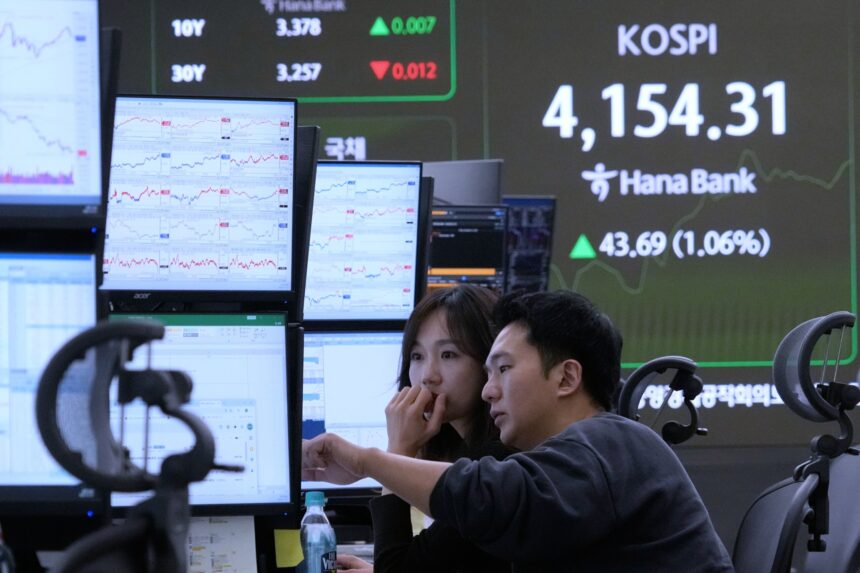
Australia’s S&P/ASX 200 index climbed 1.3% to close at 8,700.80 points, while South Korea’s Kospi increased by nearly 0.7%, reaching 4,138.64 points. Taiwan’s Taiex index added 0.2%, with India’s BSE Sensex gaining 0.4%.
On Wall Street, the S&P 500 managed to inch upwards by 0.2% to close at 6,901.00, surpassing its previous all-time closing high from October. The Dow Jones Industrial Average saw a more pronounced rise of 1.3%, closing at 48,704.01, thereby breaking its record set last month. However, the Nasdaq composite lagged, dipping 0.3% to 23,593.86 amid a decline in AI stocks.
Recent returns to record levels in the U.S. stock market come despite lingering concerns. Investors are grappling with uncertainties regarding the Federal Reserve’s interest rate strategy, as well as the profitability and productivity of significant investments in AI chips and data centers.
Earlier in the week, the Federal Reserve made headlines by cutting its main interest rate for the third time this year, signaling that another reduction could follow in 2026. Lower interest rates are generally well-received on Wall Street as they can stimulate economic growth and elevate asset prices, albeit with potential inflation implications.
However, the exuberance in U.S. markets belies ongoing anxieties. Oracle shares plummeted by 10.8%, marking a significant fall that raised concerns reminiscent of the early 2000s dot-com crisis. Doubts regarding Oracle’s hefty investments in AI technology have cast a shadow over the company and the broader AI sector, even as substantial capital continues to flow into this area.
In related market activity, Nvidia, a key player in the AI space, recorded a 1.5% decline, exerting considerable pressure on the S&P 500 due to its sizeable market capitalization.
On the commodities front, U.S. benchmark crude oil prices rose, gaining 52 cents to $58.12 per barrel, while Brent crude, the international standard, added 49 cents, reaching $61.77 per barrel. The U.S. dollar appreciated against the Japanese yen, moving from 155.58 to 155.70, although the euro slipped to $1.1737 from the previous $1.1739.