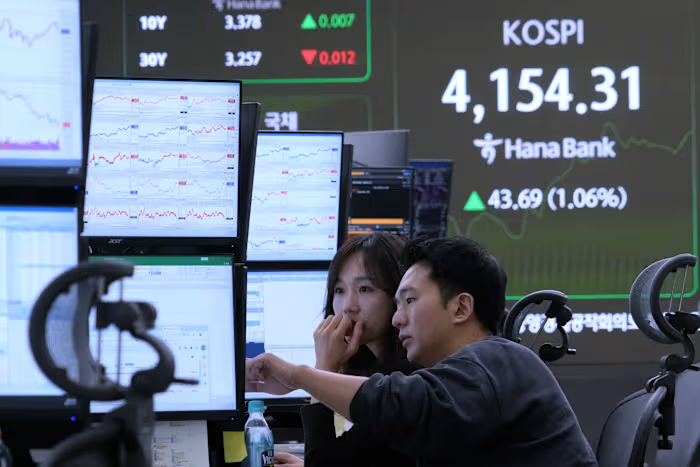
In a notable upswing, Asian shares experienced gains on Friday as they mirrored Wall Street’s record-breaking climb. This rise comes despite a significant downturn for Oracle, amid ongoing concerns regarding a potential bubble in the artificial intelligence (AI) sector. While U.S. futures saw a slight decline, oil prices continued their upward trajectory.
Japan’s Nikkei 225 index surged by 1.2%, reaching 50,768.12, recovering from losses sustained in the previous session. Investors are adopting a cautious stance as they anticipate next week’s policy meeting of the Bank of Japan, where an interest rate hike is widely expected. The technology sector played a pivotal role in these broader gains, although Softbank Group’s initial 6% jump softened to a 1% gain by midday.
In the Chinese markets, Hong Kong’s Hang Seng index rose by 1.4% to 25,881.66, while the Shanghai Composite index saw a minor increase of 0.2%, settling at 3,882.40. Importantly, upcoming annual planning discussions in Beijing—specifically the Central Economic Work Conference—are set to address China’s priorities for 2026, focusing on reversing a decline in investment and boosting consumer spending. However, no major policy changes were anticipated.
Australia’s S&P/ASX 200 index climbed 1.3% to 8,700.80, while South Korea’s Kospi increased by nearly 0.7% to 4,138.64. Taiwan’s Taiex index rose by 0.2%, and India’s BSE Sensex added 0.4%.
The previous day saw the S&P 500 inch up by 0.2% to 6,901.00, surpassing its all-time closing high from October. The Dow Jones Industrial Average leaped 1.3% to 48,704.01, breaking its own record from last month. In contrast, the Nasdaq Composite lagged, slipping 0.3% to 23,593.86 due to weakness in AI-related stocks.
This resurgence in U.S. stock market records follows a period of concerning economic indicators, such as uncertainties regarding Federal Reserve actions on interest rates. The Fed cut its main interest rate for the third time this year on Wednesday and hinted at another cut possibly in 2026. While lower interest rates tend to boost economic activities and elevate investment prices, they may also exacerbate inflation concerns.
However, the recent records in U.S. markets haven’t completely dispelled all economic anxieties. Oracle faced a significant drop of 10.8%, nearing what could be its worst loss since 2001, during the aftermath of the dot-com bubble. Investors remain skeptical about the long-term returns on the considerable investments Oracle is making in AI technology, and such reservations are affecting the entire AI industry, despite substantial capital influxes.
Adding to the mixed market sentiment, Nvidia, a leading chip manufacturer emblematic of the AI boom, saw its shares fall by 1.5%, weighing heavily on the S&P 500 due to its size.
In commodity markets, U.S. benchmark crude oil rose by 52 cents to $58.12 per barrel, and Brent crude gained 49 cents to $61.77 per barrel. The U.S. dollar appreciated slightly against the Japanese yen, rising to 155.70 from 155.58, while the euro experienced a minor decline, falling to $1.1737 from $1.1739.