The Indian stock market’s reaction to the U.S. Federal Reserve’s recently announced rate cut has been notably subdued, defying expectations of a more robust response. The benchmark indices opened slightly lower and exhibited volatility throughout the session. At one moment, the Sensex dipped by 0.28% to 84,150, while the Nifty 50 managed to surpass the 25,700 mark. Despite some visible buying activity, it remained muted, especially given this marked the third consecutive rate cut by the U.S. Fed amid ongoing selling pressure from foreign investors seen in recent trading days.
In the past three sessions, both the Nifty and Sensex have experienced a cumulative decline of approximately 1.6%, largely attributed to consistent foreign selling, which has also contributed to the Indian rupee hitting a record low earlier this month.
The latest Federal Open Market Committee meeting concluded with the Fed cutting its policy rate by 25 basis points to a range of 3.5-3.75%, a move anticipated by many analysts due to concerns regarding the labor market. This decision comes in the context of inflation rates remaining elevated and policymakers expressing caution about potential tariff-related pressures.
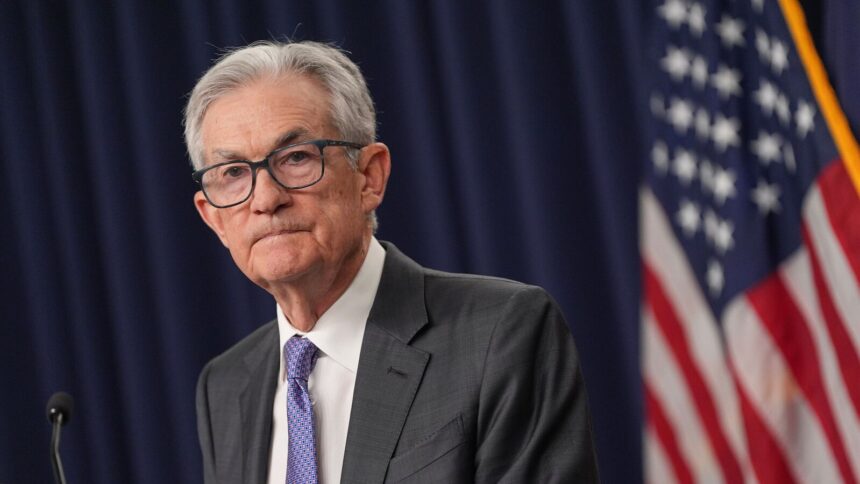
Following the announcement, Fed Chair Jerome Powell indicated that the current interest rate policy is equipped to respond appropriately to future economic developments, though he refrained from providing guidance on the possibility of further rate cuts in the near term. Notably, the Fed’s decision was not without controversy, as three members of the committee dissented from the decision to cut rates, a point that analysts believe highlights the complex policy path ahead.
The markets appear to be reacting cautiously to this rate cut. Current projections suggest one more rate cut may occur in 2026 and another in 2027. However, the recent market sentiment has priced in nearly three rate cuts by the end of 2026. Analysts are concerned that the latest rate cut does not equate to a significant recovery for the Indian stock market, which faces structural challenges, including a weakened rupee and persistent foreign institutional investor (FII) selling.
Dr. VK Vijayakumar, Chief Investment Strategist at Geojit Investments, articulated that while the Fed’s decision might seem favorable, it is unlikely to substantively boost the Indian market. The sustained outflows from FIIs, amounting to ₹14,051 crore in December alone, alongside a total outflow of ₹157,726 crore as of December 10, coupled with reduced earnings growth and an oversupply of IPOs, present significant challenges.
Market analysts have expressed that traders interpret the Fed’s cut not as a vote of confidence but as a precautionary measure in light of emerging macroeconomic weaknesses. As a result, while large-cap stocks may stabilize, riskier segments such as midcap and smallcap indices continue to languish, struggling to regain critical support levels despite global easing.
Looking ahead, Dr. VK Vijayakumar suggested that the scenario might shift positively if IPO activity slows down in 2026 and earnings growth improves as anticipated. He views the current market weakness as an opportunity to invest in high-quality stocks, especially within the large-cap sector and selectively in midcaps, although he cautioned that broader market weaknesses might persist in the interim.
Investors are advised to remain cautious and consult with certified experts, as market conditions could shift rapidly and individual circumstances may vary significantly.