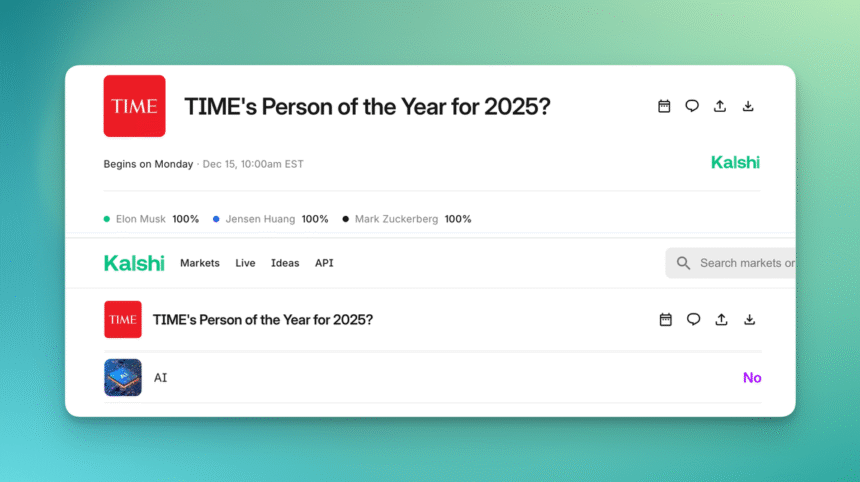
In a surprising turn of events, bettors on prediction markets Kalshi and Polymarket are expressing frustration after Time magazine awarded its coveted Person of the Year title to the “Architects of AI,” rather than to the AI itself, as many had anticipated. The decision has sparked outrage among punters who risked over $6 million on the assumption that “AI” would grace the magazine’s cover.
A significant portion of the betting community is venting their dissatisfaction online, with various users taking to social media platforms to voice their grievances. One Kalshi bettor succinctly captured the collective frustration, exclaiming, “This pretty clearly should’ve resolved to yes,” urging fellow bettors to contact customer support in light of the seemingly ambiguous naming.
Responses have ranged from incredulous anger to outright calls for refunds. A bettor insisted that the resolution should acknowledge “AI” since it was visibly present on the cover and in the title. Another user declared, “Another misleading bet by Kalshi,” attributing unfairness to the platform compared to Polymarket’s stricter rules, which ultimately disallowed specific bets on AI but honored bets on the individual architects like Sam Altman and Elon Musk.
Polymarket has laid out its rationale in a statement, emphasizing that the decision to determine a winner is contingent upon the explicit naming of the Person of the Year rather than what is depicted on the cover. For instance, it clarified that had Time designated “The MAGA Movement” as its Person of the Year rather than Donald Trump, bets placed on Trump would not be honored, demonstrating the platform’s commitment to strict naming conventions.
The announcement from Time also reignited debates around the anthropomorphization of AI. Many in the betting community seemed to ignore that AI, as a non-sentient entity, does not traditionally qualify as a “person.” Throughout its history, Time has often selected groups or concepts as its Person of the Year, an approach illustrated by past selections like “The Silence Breakers” and “The Good Samaritans.”
Additionally, the volatility and unpredictability of these betting platforms have raised eyebrows. Recent months have seen users raise concerns over the integrity of the bets, as evidenced by a controversial incident involving a live map of the Ukraine War that allowed gamblers to profit from a fabricated battle, as well as questions surrounding a trader who allegedly profited significantly in just one day by betting on upcoming Google search rankings.
With over $55 million wagered on the Time Person of the Year on Polymarket and more than $19 million on Kalshi, the incidents underscore not just the stakes involved in these prediction markets, but also the complexities and potential pitfalls associated with gambling on unpredictable social phenomena. As these platforms continue to evolve and integrate with mainstream media outlets, users remain cautious yet invested in a gambling culture that often flirts with chaos.