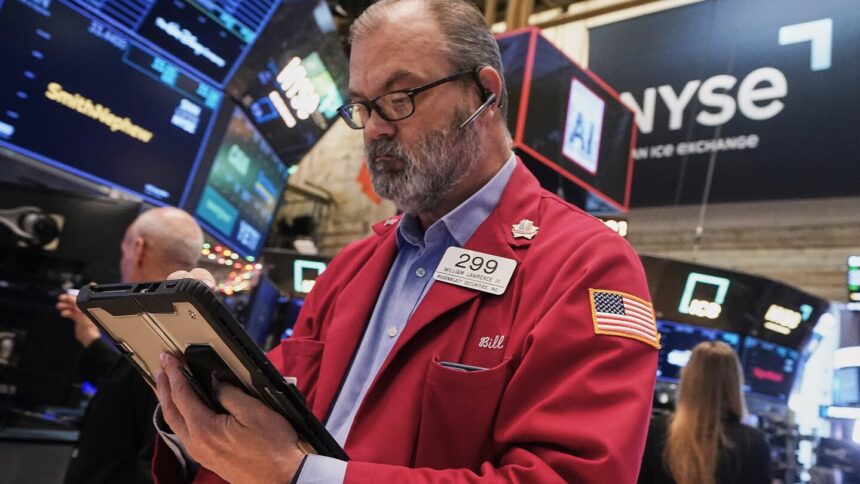
The latest market developments have seen a significant downturn for major artificial intelligence stocks, pushing Wall Street off its recent record highs. On Friday, the S&P 500 faced a notable decline, falling 1.1% from its all-time peak, marking its worst performance in three weeks. The technology-heavy Nasdaq composite took an even harder hit, plummeting 1.7%, while the Dow Jones Industrial Average dipped by 245 points, or 0.5%, shortly after reaching its own record.
A major contributor to this downfall was Broadcom, whose shares fell sharply by 11.4% despite the company reporting better-than-expected profits for the recent quarter. Analysts characterized Broadcom’s performance as solid, with CEO Hock Tan highlighting a remarkable 74% growth in AI semiconductor revenue. However, investor concerns regarding the company’s financial forecasts and potential profit margins raised red flags. After a staggering 75.3% rise in its stock this year—outpacing the broader S&P 500’s gains—many suggested that Broadcom might simply be experiencing a loss of momentum.
This drop in Broadcom shares echoed worries about the broader AI sector, intensified by Oracle’s nearly 11% plunge the previous day, even though it, too, announced a larger-than-expected profit for its latest quarter. Investors are questioning whether Oracle’s hefty expenditures on AI technology will yield sufficient returns and how the tech giant plans to finance these investments, thus raising concerns for the industry as a whole.
Broadcom’s decline was the most substantial weight on the S&P 500, followed closely by Nvidia, which saw a decrease of 3.3%, and Oracle, which fell another 4.5%. Additionally, the bond market exerted further pressure, as the yield on the 10-year Treasury rose to 4.18% from 4.14% the night before. Higher yields can often dissuade investors from paying premium prices for stocks, especially when valuations appear elevated.
The recent downturn in prominent AI stocks has contrasted sharply with the performance of companies less reliant on technology, particularly those in the Dow Jones Industrial Average, which enjoyed a 1% increase over the past week, in stark contrast to the Nasdaq composite’s 1.6% drop. In spite of rising yields, investor sentiment regarding interest rates has shown signs of optimism following the Federal Reserve’s third interest rate cut this year and indications that further cuts could be possible in 2026.
Fed Chair Jerome Powell had earlier suggested that interest rates might remain stable for some time. His comments appeared less severe than anticipated, calming investor fears about the possibility of increased rate hikes.
The day saw relatively strong performances for consumer-dependent stocks within the S&P 500, with two out of every five companies registering gains. Easing oil prices are helping to alleviate consumer expenses, raising expectations that reduced interest rates will stimulate spending. Standout gainers included Chipotle Mexican Grill, which rose 3.6%, McDonald’s, climbing 2.3%, and Norwegian Cruise Line, which added 1.5%. Lululemon Athletica experienced the most significant rise of the day, leaping 9.6% after surpassing analyst expectations for profit and revenue. However, the company announced that its CEO, Calvin McDonald, will step down at the end of January due to pressures to enhance revenue.
In summary, the S&P 500 ended the day down 73.59 points, closing at 6,827.41, with the Dow Jones falling 245.96 points to 48,458.05, and the Nasdaq composite dropping 398.69 points, closing at 23,195.17. Meanwhile, international markets saw modest declines in European indexes but a strong performance in Asia, with stocks in Hong Kong climbing 1.7% and a 1.4% increase in Tokyo.