When the Dallas Marathon first took place in 1971, a modest group of 82 local runners tackled the 26.2-mile course around White Rock Lake. Fast forward to this weekend, and the event has ballooned to include over 30,000 participants, marking a significant uptick in interest and participation. This surge is particularly noteworthy when compared to the statistics from previous years; in 2019, about 15,000 runners took part, while 2021 saw that figure rise to 26,000.
The Dallas Marathon, now branded the BMW Dallas Marathon, reflects a broader trend in the running community, where events have regained and even surpassed pre-pandemic participation levels. The COVID-19 lockdown led many to adopt running as an accessible form of exercise, contributing to a global running boom. Esteemed races like the New York City Marathon and the London Marathon reported record entries in the aftermath of the pandemic, and new running clubs gained traction, bolstered by the surge in popularity of fitness apps like Strava.
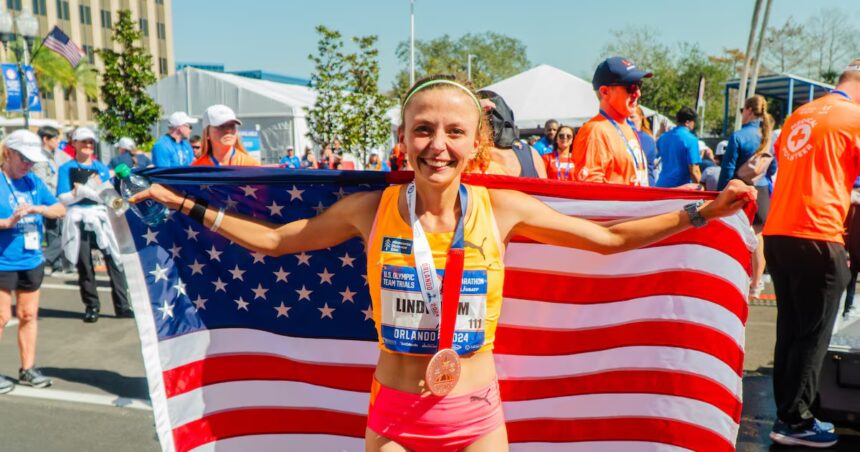
This weekend’s race will see notable athletes join the ranks of the everyday runners. One exceptional participant is Dakotah Popehn, an Olympian who has recently made headlines for her impressive marathon results. Popehn, who previously competed under the name Lindwurm until her marriage in 2024, will be racing in the half-marathon. Although she plans to use the event as a workout rather than a competitive race, her participation marks a unique occurrence for this annual event, as previous celebrity ambassadors did not typically race.
“Celebrity ambassadors always help elevate the event, but it’s something truly special when someone of [Popehn’s] caliber steps off the sidelines and into the race itself,” remarked Jason Schuchard, president of the BMW Dallas Marathon.
Excitement looms not just for Popehn’s potential performance, but also for her personal exploration of Dallas, as she mentioned, “There’s no better tour [of Dallas] than a 13-mile-long run.” While she may not be fully familiar with the city, she is aware of local young talent such as Cooper Lutkenhaus, a standout high school runner who recently competed in the World Track and Field Championships.
Popehn reflected on the comparative worlds of distance running and sprinting, envisioning scenarios where she might hold her own against shorter distance specialists like Lutkenhaus. She playfully speculated that in a longer race, such as a half-marathon, she would stand a better chance of surpassing him.
Established in 2003, the half-marathon has become a staple of the BMW Dallas Marathon weekend. The current course record of 1:11:32 was set by Romanian runner Nuta Olaru in 2008. Given Popehn’s personal best of 1:07:42, she might come close to breaking that record, even while treating the race as merely a progression run. Her career gained significant recognition after her strong showing at the U.S. Olympic Trials, where she finished third. Out of her marathon accomplishments, she secured a noteworthy 2:24.20 in Chicago, placing her 19th on the all-time fastest list for American women.
Popehn attributes her success to maintaining consistency and avoiding injuries throughout her training. She emphasized the importance of taking care of one’s body and being adaptable, stating, “The single most important thing has been consistency and not having to take time off due to injury.”
She also aims to inspire younger athletes who may feel discouraged after recent Division I signing decisions. Reflecting on her own journey, she noted that athletes can find opportunities at various levels of competition, asserting, “As long as you’re able to continue the career in some way, Division I doesn’t have to be the only way.”
Training in the challenging climate of Minnesota and South Dakota has shaped Popehn’s resilience. She noted that new runners in Dallas may not find perfect conditions for training but encouraged them to focus on the effort rather than specific times, advising, “What you’re not getting out of it in a physical aspect, you’re gaining a lot in a mental aspect.”
For this weekend’s marathon, scheduled to start and finish at Dallas City Hall plaza, Popehn suggested that runners embrace the challenges they will face. “When things are hard, especially in mile 20 of a marathon, think back to all the hard things you did in your training block to give you the confidence to overcome whatever adversity you’re feeling on the course.”
As the event approaches—set against a predicted partly cloudy and somewhat brisk backdrop—anticipation builds among participants and enthusiasts alike, marking yet another chapter in the rich history of the Dallas Marathon.