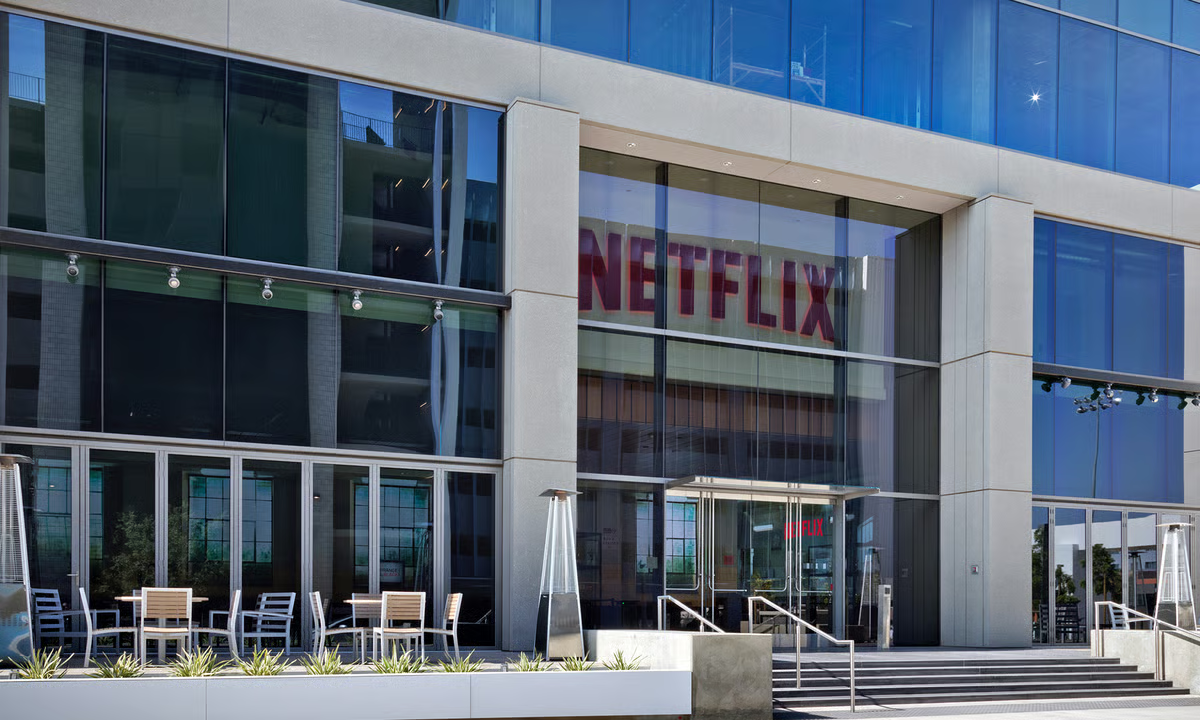
Stock splits are often seen as a positive indicator of a company’s strong performance, and Netflix, a pioneer in the streaming industry, recently executed a 10-for-1 forward stock split, underscoring its robust financial health. Since its initial public offering (IPO) in 2002, Netflix’s stock has soared an astounding 80,730%, reflecting its transformative impact on how consumers access entertainment.
To be included in the S&P 500, a company must satisfy several stringent criteria, including a minimum market capitalization of $22.7 billion, substantial liquidity, and consistent profitability over recent quarters. Netflix first entered this prestigious index in December 2010, and its inclusion has been bolstered by a continuous streak of impressive business results.
In its latest earnings report, Netflix recorded a 17% year-over-year revenue increase, totaling $11.5 billion, while adjusted earnings per share (EPS) rose 27% to $6.87. Management remains optimistic, projecting fourth-quarter revenue of $11.96 billion and an EPS increase of 28%.
In a significant move, Netflix has announced plans to acquire assets from Warner Bros. Discovery for $82.7 billion, a deal that includes Warner Bros.’ film and television studios along with HBO and HBO Max’s streaming platforms. This acquisition must still receive regulatory approval, but both companies’ boards have already unanimously endorsed it.
Simultaneously, controversy has arisen as Paramount Skydance made a hostile takeover bid for Warner Bros. Discovery, offering $30 per share directly to shareholders. Despite the potential uncertainty this brings, Netflix’s co-CEO Ted Sarandos expressed confidence during an investor conference, asserting that their deal is well-structured and beneficial to both shareholders and consumers.
To capitalize on the acquisition, Netflix plans to leverage its sophisticated data analytics and licensing capabilities. This strategy aims to extract greater value from Warner Bros.’ extensive content library, thereby bolstering Netflix’s offerings and maximizing user engagement.
Analysts have shown cautious optimism regarding the acquisition, with many acknowledging concerns about the price and integration challenges due to varying corporate cultures. Nevertheless, a majority of Wall Street analysts maintain a positive outlook on Netflix. Among the 42 industry analysts, approximately 67% recommend a buy or strong buy, while the average price target suggests a potential upside of 34% from the current trading price.
While Netflix’s current valuation stands at 39 times earnings, which is lower than its three-year average of 45, this makes the stock seem more attractive. The company’s historical performance, as demonstrated by a staggering 687% increase over the past decade, significantly outpaces the 233% growth of the S&P 500. Given these factors, Netflix continues to be viewed as a strong investment opportunity moving forward.