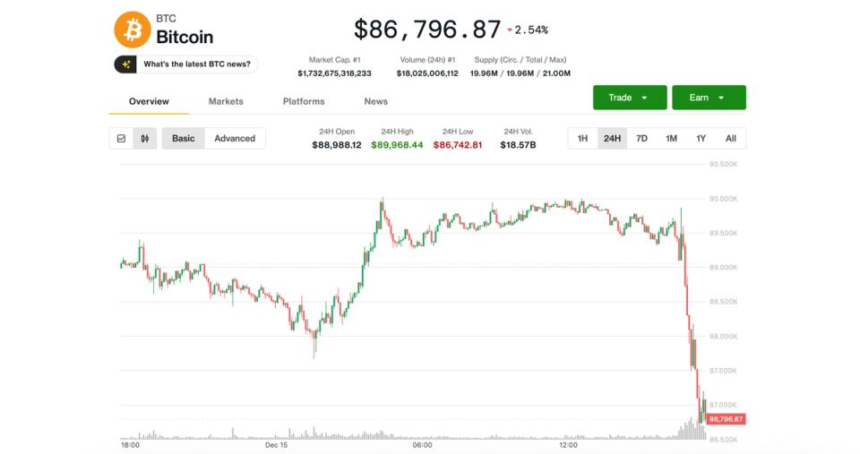
Major cryptocurrencies experienced a significant downturn during the U.S. morning hours on Monday, maintaining a troubling trend of underperformance amid trading in American stocks. Bitcoin, which had been trading relatively flat around $90,000 overnight, sharply declined to approximately $86,800 by mid-morning.
Market analysis from Bespoke Investment highlighted a stark contrast in performance related to the newly launched iShares Bitcoin ETF. Investors who held the ETF only during after-hours trading saw a remarkable gain of 222%. In contrast, those who executed trades during regular hours—buying at the open and selling at close—suffered a loss of 40.5%.
The downward movement wasn’t limited to Bitcoin alone; several crypto-related stocks also opened the week on a negative note. Strategy and Circle saw their shares drop by approximately 7%, while Coinbase experienced a decline of over 5%. Trading platforms like Robinhood and eToro faced smaller setbacks, each decreasing by around 2%. Notably, brokerage Gemini, which had recently surged following the approval of prediction markets, saw a pullback of 10%.
Crypto miners, closely linked to the data center infrastructure sector—which faced challenges the previous week due to concerns over artificial intelligence—continued their downward trend. Companies such as CleanSpark, Cipher Mining, Hut 8, and TeraWulf each recorded declines exceeding 10%.
In the broader economic landscape, the U.S. government is gearing up for a significant release of employment reports for both October and November by the Bureau of Labor Statistics. These reports will be critical in determining the future trajectory of interest rates, particularly as the Federal Reserve considers possible cuts in early 2026.
In international finance, the Bank of Japan is anticipated to increase its benchmark interest rate for the first time in nearly a year. Additionally, both the Bank of England and the European Central Bank are scheduled to convene later this week to deliberate on their respective monetary policies, potentially adding further complexity to the global financial environment.