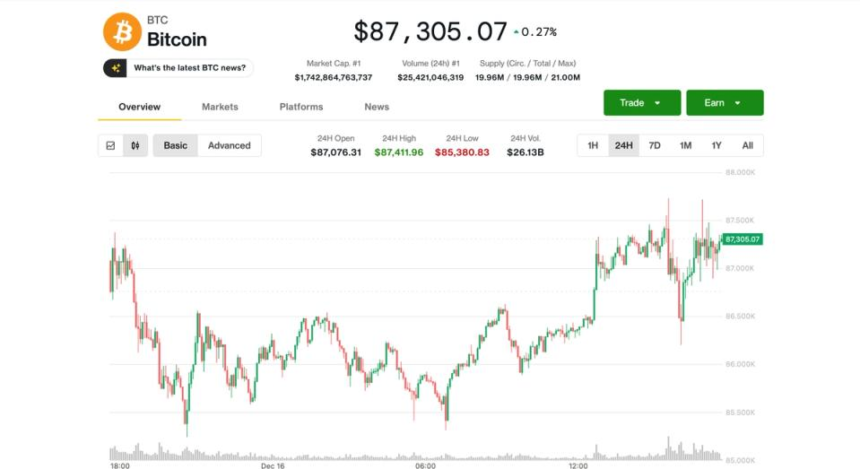
Cryptocurrencies have shown signs of stabilization following a tumultuous selloff on Monday. In the early U.S. trading session on Tuesday, Bitcoin rebounded to trade above $87,000, marking a recovery of about 3% from its overnight lows. In contrast, Ethereum demonstrated a more subdued performance, gaining only 1.4% to approximately $2,921.02. Among altcoins, notable performers included BNB, XRP, and SUI, which each experienced increases between 3% to 6%.
The rebound in the cryptocurrency market also extended to crypto-related equities, which experienced a recovery after the preceding day’s panic. Companies like MicroStrategy (MSTR) and Robinhood (HOOD) saw their stock values increase by 3% to 4%, while Circle, the issuer of the $78 billion USDC stablecoin, surged 9%. Interestingly, on this day, cryptocurrencies were outperforming U.S. equities, which saw modest declines, with the S&P 500 down by 0.5% and the Nasdaq off 0.3%.
The backdrop to this market activity included delayed U.S. employment reports, revealing a concerning rise in the unemployment rate to a four-year high of 4.6% in November. Despite this unsettling news, expectations regarding a potential Federal Reserve rate cut in January remain muted, with only a 24% probability assigned.
Market analysts are debating whether the current uptick in Bitcoin prices represents a temporary “dead cat bounce” or signals a more sustained recovery. Samer Hasn, a senior market analyst at XS.com, expressed skepticism, labeling Bitcoin’s recent rise from the November low of $80,000 as merely a “corrective high.” He anticipates that the next phase could see Bitcoin drop below the $80,000 mark once again.
Hasn emphasized the market’s fragile state, noting that derivatives trading indicated caution among investors. Over the past two days, there were $750 million in long liquidations, a significant portion of which—around $250 million—was linked to Bitcoin futures. He observed that traders may either be exercising caution in anticipation of upcoming economic data or facing forced exits, which only reinforces the downward momentum in the market.
David Hernandez, a crypto investment specialist at 21shares, described the current landscape as a tactical struggle between the delay of monetary easing policies and Bitcoin’s long-term potential as a store of value. In light of this, immediate selling pressure might arise as traders reassess risks, thereby challenging Bitcoin to maintain critical support levels. Hernandez noted that the existing economic tension could bolster the case for long-term investment in Bitcoin, as its finite supply positions it as a valuable asset amid an environment where the Fed is grappling with inflation without jeopardizing economic stability.