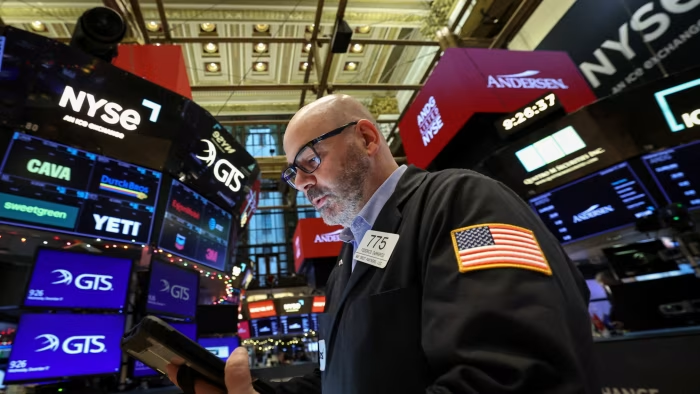
US tech stocks experienced a notable decline on Wednesday, as investor apprehensions resurfaced regarding the financial sustainability of artificial intelligence companies, following Oracle’s loss of a crucial backer for its data centre project. The tech-heavy Nasdaq Composite index fell 1.3 percent by early afternoon in New York, with Oracle’s shares plummeting 5 percent after Blue Owl Capital, its primary financier for US data centre initiatives, decided not to proceed with funding a $10 billion data centre in Michigan.
This development marks a significant downturn for Oracle, whose stock has now seen a nearly 50 percent drop since its peak in early September. The company is increasingly viewed as a focal point of Wall Street’s anxiety surrounding the substantial debt being accumulated to finance the expansion of AI-related infrastructure. The recent decline follows a sell-off last week triggered by Oracle’s disappointing earnings, alongside similar results from chipmaker Broadcom, which did not meet elevated investor expectations.
The broader tech sector saw declines, with notable drops including Nvidia, which fell 3.4 percent, and Alphabet, down 2.6 percent. Broadcom also witnessed a 5.4 percent decrease. “The Oracle news is certainly the main factor,” commented Mike Zigmont, co-head of trading and research at Visdom Investment Group. He noted that Blue Owl’s decision to withdraw funding is perceived by many in the market as a signal of reduced optimism about the AI boom.
Meanwhile, the blue-chip S&P 500 index dipped 0.8 percent, reflecting the impact of the renewed anxiety in the tech sector. Despite the recent downward pressure, the S&P 500 remains close to its record closing levels achieved just last week. Arun Sai, a strategist at Pictet Asset Management, attributed the market movements to profit-taking behaviors among investors who benefited from AI-linked investments throughout the year. “Investors are increasingly seeing their AI holdings as a funding source for next year’s trades,” Sai added, suggesting a shift in investment strategies amidst growing concerns.