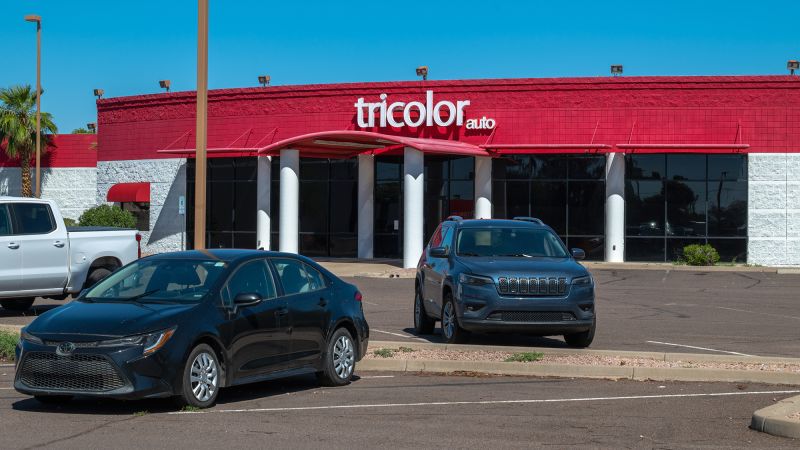
Federal prosecutors have brought charges against top executives at Tricolor, a subprime auto lender that recently declared bankruptcy, alleging a conspiracy to defraud lenders and investors. The company, which specialized in providing loans and selling used cars primarily to undocumented immigrants who lacked Social Security numbers or credit histories, filed for bankruptcy in September.
The indictment, revealed this week in Manhattan, claims that Tricolor’s founder and CEO, Daniel Chu, was at the helm of a scheme that defrauded lenders of billions of dollars. “Fraud became an integral component of Tricolor’s business strategy,” stated Jay Clayton, U.S. Attorney for the Southern District of New York. He noted that the resulting collapse negatively impacted banks, investors, employees, and customers alike.
According to the indictment, under Chu’s direction, multiple executives at Tricolor engaged in deceptive practices, including “double-pledging collateral,” which involves using the same assets as collateral for multiple loans from different lenders.
Alongside Chu, the company’s Chief Operating Officer, David Goodgame, is a key defendant. Two former executives, Jerome Kollar and Ameryn Seibold, have already pled guilty and are cooperating with investigators.
As Tricolor neared its downfall in August, the indictment claims that Chu ordered Kollar to pay him $6.25 million in bonuses, despite the business’s precarious state. Reports suggest that Chu utilized a portion of this money to purchase a high-value property in Beverly Hills, California. This sequence of events unfolded shortly before Tricolor placed over 1,000 employees on unpaid leave, ultimately leading to its bankruptcy filing a month later.
In the wake of the bankruptcy, several major banks that had extended loans to Tricolor have alerted their investors about potential fraud. JPMorgan Chase, the largest bank in the U.S., indicated that it would incur a $170 million loss from transactions involving Tricolor. JPMorgan’s CEO, Jamie Dimon, opined that the losses were indicative of fraud, stating, “there clearly was, in my opinion, fraud involved in a bunch of these things.” He added a metaphor, suggesting that when one fraudulent activity is identified, others are likely present as well.
Fifth Third Bank also disclosed that it was collaborating with law enforcement to investigate apparent fraud linked to its dealings with a commercial lender, resulting in a $200 million loss. A spokesperson later confirmed that Tricolor was the commercial borrower in question.
Furthermore, a court-appointed trustee overseeing Tricolor’s bankruptcy case mentioned in October that instances of “pervasive fraud” had become evident, describing the scale of the deceit as “extraordinary.” This ongoing investigation continues to unravel the extent of fraudulent activities tied to the now-defunct auto lender.