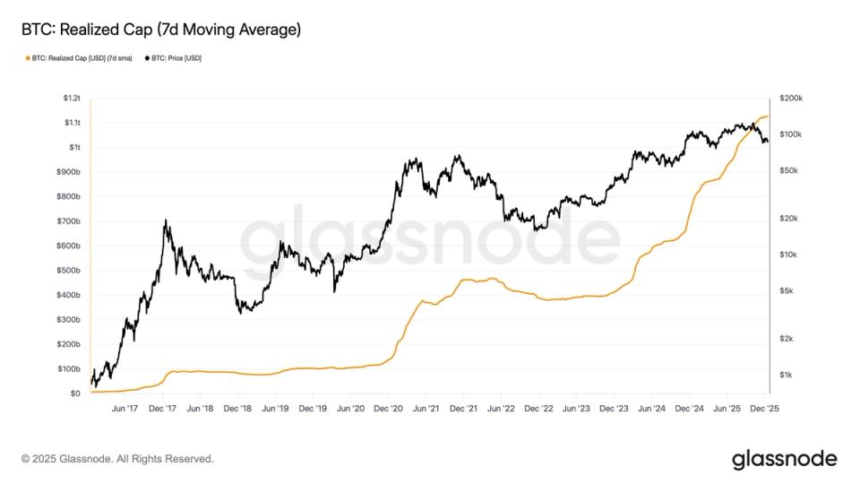
Bitcoin’s “realized capitalization” has reached an unprecedented $1.125 trillion, indicating that the cryptocurrency remains bullish despite experiencing a nearly 40% drop in prices over the past ten weeks. This on-chain metric, which assesses the value of each bitcoin based on its last movement price, offers a clearer picture of actual capital inflows as opposed to the speculative nature of total market capitalization.
Data from Glassnode shows that realized capitalization continued to increase through a 36% correction following the record price peak in October. Although it has hit a plateau around the $1.125 trillion mark recently, this stagnation mirrors a previous situation in April 2025. During that period, bitcoin’s value had similarly dipped, resting briefly near $76,000 before rebounding to achieve new highs.
The dynamics seen in the current market contrast sharply with the bear market of 2022, when realized capitalization fell from approximately $470 billion to $385 billion as investors capitulated, leading to the sale of coins at a diminished cost basis. Such a response of panic selling appears absent in the current situation.
Adding complexity to the analysis, Andre Dragosch, the European head of research at Bitwise, suggests that bitcoin might challenge the traditional four-year cycle narrative, hinting at potential upside surprises in 2026. He attributes this potential to resilient global growth coupled with ongoing rate cuts, which could steepen the yield curve and enhance liquidity. Such conditions could exert downward pressure on the U.S. dollar, a scenario that has historically been advantageous for bitcoin.
Dragosch argues, “In my view, bitcoin is materially underpricing the prevailing macro backdrop, to a degree last seen during the Covid recession and the FTX collapse, despite no signs of a U.S. recession and evidence of re-accelerating growth.” This perspective hints at a potential reassessment of bitcoin’s value in light of favorable macroeconomic conditions moving forward.