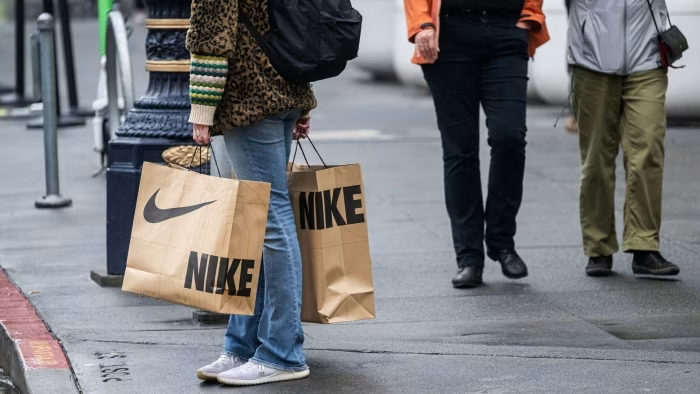
Nike’s latest quarterly earnings report has raised concerns among investors, as the company’s sales experience a notable downturn in its crucial Chinese market. In the financial figures released for the quarter ending November 30, Nike’s shares plummeted over 10% in after-hours trading, reflecting investor fears amid an ongoing business slump.
Chief Executive Elliott Hill, who was brought out of retirement to lead the company’s recovery, characterized Nike’s current position as being in the “middle innings of our comeback.” The company has faced increased competition from emerging brands, such as running shoe manufacturers On and Hoka. Hill emphasized that regaining the trust and loyalty of athletes and consumers will be key to Nike’s future success.
Global revenue saw a modest increase of 1% to $12.4 billion, surpassing analysts’ consensus estimate of $12.2 billion. However, this figure is approximately $1 billion lower than sales recorded in the same quarter two years prior. While North America and the Europe, Middle East, and Africa regions reported revenue growth, sales in greater China plummeted by 17% to $1.4 billion. A significant factor contributing to this decline was a drop of $249 million in footwear sales, as analysts indicated that store traffic was diminishing and excess inventory was leading to increased markdowns.
Matthew Friend, Nike’s Chief Financial Officer, explained that the company had encountered a variety of issues in China, including ineffective investments in its store fleet, which the management described as “not compelling.” In response to these challenges, Hill noted that Nike plans to increase investments in its Shanghai and Beijing locations to improve store appeal. He acknowledged that the company’s strategy in China requires a “reset,” particularly in adapting to the nation’s sprawling e-commerce landscape, although he cautioned that this transformation would require time.
Earlier in the month, Nike implemented a significant leadership shakeup, appointing Venkatesh Alagirisamy as Chief Operating Officer, responsible for overseeing technology and operations. This restructuring involved eliminating the roles of Chief Technology Officer and Chief Commercial Officer, with leaders of Nike’s principal regions now reporting directly to Hill.
Despite the challenges faced this quarter, Hill indicated that performance slightly surpassed internal expectations set 90 days prior. However, the company also cited a decline in its gross profit margin, which dropped by 3 percentage points to 40.6%. This decline has been primarily attributed to increased tariffs in North America—an annual cost estimated at $1.5 billion, which has been a consequence of trade tensions initiated during the Trump administration.
As Nike navigates these tumultuous market conditions and strives to reclaim its foothold in China, the road to recovery appears to involve strategic reinvestments and an assessment of its approach to consumer engagement and operational efficiency.