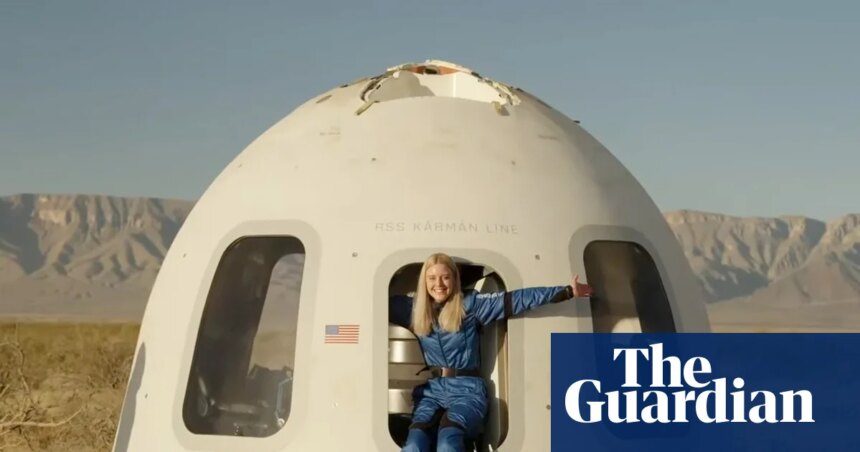
In a groundbreaking moment for space travel and inclusivity, a paraplegic engineer from Germany embarked on an extraordinary journey to space on Saturday, marking her as the first wheelchair user to achieve this milestone. Michaela Benthaus, who has faced the challenges of being in a wheelchair since a severe mountain biking accident seven years ago, launched from west Texas aboard a Blue Origin rocket, alongside five other passengers.
The flight, sponsored by Blue Origin, was aided by Hans Koenigsmann, a retired SpaceX executive who played a pivotal role in organizing this mission. Although the ticket prices were not disclosed, the initiative showcased a progressive approach to space accessibility. Benthaus expressed her sheer delight during the journey, stating, “I laughed all the way up,” and recalled the breathtaking view of Earth from over 65 miles (105 km) above. Her experience in space was further enriched by her attempt to flip upside down during the flight, describing it as “the coolest experience.”
Blue Origin, founded by billionaire Jeff Bezos, has made strides in making space travel accessible. Their New Shepard capsule, which operated autonomously during the mission, was specifically designed to accommodate a diverse group of passengers, including those with limited mobility. Jake Mills, an engineer at Blue Origin, emphasized the company’s commitment to inclusivity, noting that the flight was engineered to cater to a broader range of individuals than traditional spaceflights. In the past, Blue Origin has welcomed passengers with various disabilities, including visual and hearing impairments, and even a pair of nonagenarians.
To facilitate Benthaus’s journey, the team made necessary adjustments, such as incorporating a patient transfer board to assist her in moving between the capsule’s hatch and her seat. Additionally, a carpet was laid out on the desert floor for a smooth transition back to her wheelchair upon landing. This meticulous planning involved advance practice sessions, with Koenigsmann participating in both the design and testing phases to ensure a seamless experience for Benthaus.
At just 33 years old, Benthaus has been actively involved with the European Space Agency’s graduate trainee program in the Netherlands. Prior to this mission, she had experienced weightlessness during a parabolic airplane flight in 2022 and participated in a two-week simulated space mission in Poland. Despite her adventurous spirit, Benthaus was initially skeptical about her chances of flying to space. “I never really thought that going on a spaceflight would be a real option for me,” she reflected, given the competitive nature of space travel.
Her dreams reignited when Koenigsmann approached her last year with the remarkable opportunity to fly with Blue Origin. Initially doubting that such an opportunity could be real, she quickly embraced it, signing on without hesitation. This mission remained a private endeavor, separate from the European Space Agency, which recently approved future flights for astronauts with disabilities.
Benthaus’s situation differs from that of John McFall, a reserve astronaut who lost a leg in a motorcycle accident. While McFall is able to evacuate a space capsule autonomously, Benthaus requires assistance due to her complete paralysis. Following the flight, Koenigsmann and another team member helped lift her down from the capsule.
In her reflection after the successful flight, Benthaus urged, “You should never give up on your dreams.” She is committed to advocating for greater accessibility in space and on Earth, hoping that her journey will serve as a stepping stone toward more inclusive opportunities for those with disabilities.
Benthaus shared the flight with business executives, investors, and a computer scientist, raising the count of Blue Origin’s space travelers to 86. Since its inception in 2000, Blue Origin has made significant advancements in space travel, including launching its first passenger flight in 2021 and developing larger rockets for missions. As the company continues its efforts to send landers to the moon, the inclusion of individuals like Benthaus illustrates a promising future for accessible space exploration.