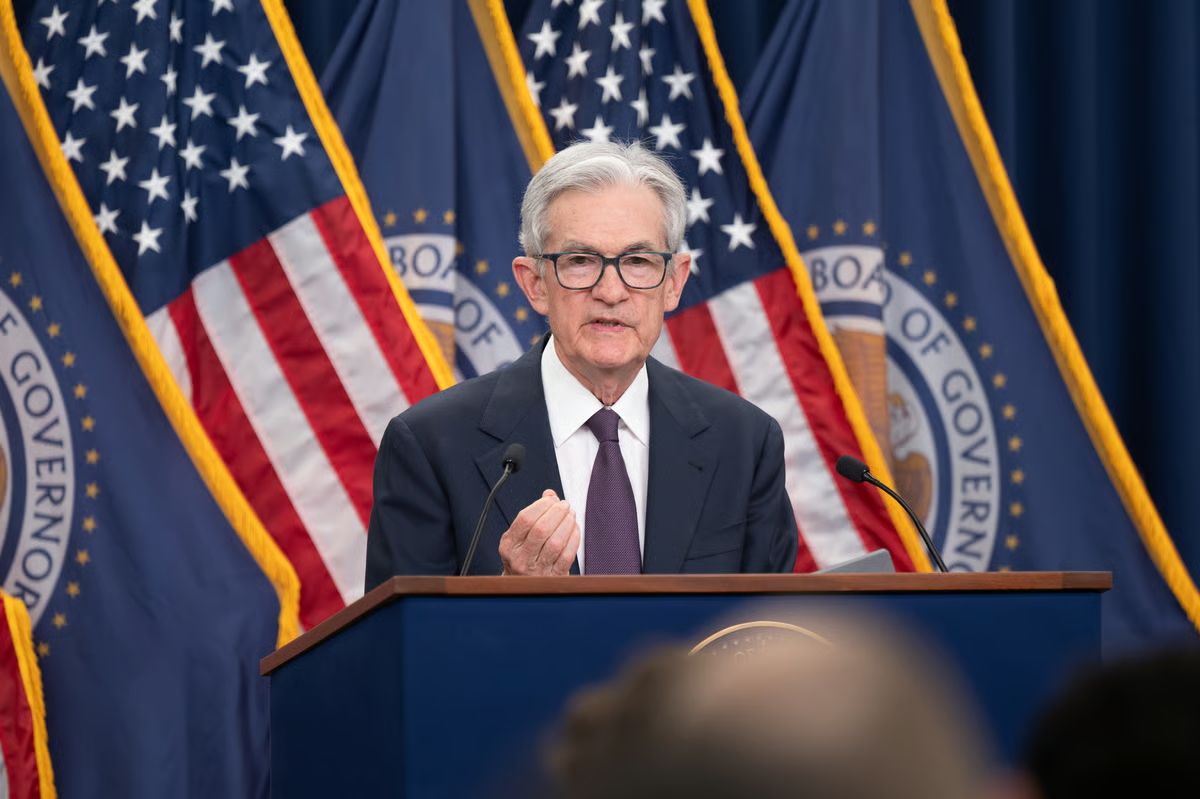
Amidst the economic turbulence caused by President Trump’s tariffs, the Federal Reserve is experiencing an unusual division regarding interest rates. The U.S. stock market has defied expectations, posting a striking 16% increase in the S&P 500 so far this year, nearly doubling the historical average. However, the Federal Reserve has subtly signaled concerns about this economic landscape, hinting at a potential “silent warning” regarding elevated stock market valuations and the risk of an artificial intelligence bubble.
The latest meeting of the Federal Open Market Committee (FOMC) in December showcased this internal discord. While a 25 basis point interest rate cut was executed as anticipated, dissent among members was notable. Chicago Fed President Austan Goolsbee and Kansas City Fed President Jeffrey Schmid advocated for holding interest rates steady, while Governor Stephen Miran pushed for a more significant cut of 50 basis points. This kind of dissent is exceedingly rare; it occurred at the last FOMC meeting thrice, a marked contrast to a two-decade span where no members dissented at all.
Such disagreements signal underlying uncertainties, and the stakes are high. With tariffs increasing the tax burden on U.S. imports to levels unseen since the 1930s, policymakers find themselves in a harsh bind. Rising inflation and unemployment complicate any attempts to formulate an effective monetary policy, as a focus on controlling one may aggravate the other. This dysfunction has made it difficult for Fed officials to interpret current economic conditions, further clouding the outlook for investors and contributing to rising apprehension within the stock market.
Historically, periods with multiple dissents have not necessarily led to declines in stock prices. For example, following a similar incident in 1988, the S&P 500 saw a 16% increase in the subsequent year, although current market conditions differ significantly, particularly regarding valuations. Currently, the S&P 500’s cyclically adjusted price-to-earnings (CAPE) ratio stands at 39.2, a level reminiscent of the dot-com bubble. Such elevated valuations are normally associated with poor future performance, as evidenced by data suggesting an average decline of 4% in the year following similar readings.
In the context of current economic conditions, investors may find themselves in uncharted waters. With the stock market’s robust performance amidst prevailing uncertainties, along with the abnormalities within the Federal Reserve, the outlook for 2026 seems increasingly precarious. While past performance cannot ensure future results, the likelihood of a decline appears tangible, urging investors to brace themselves for what might be a more challenging year ahead.