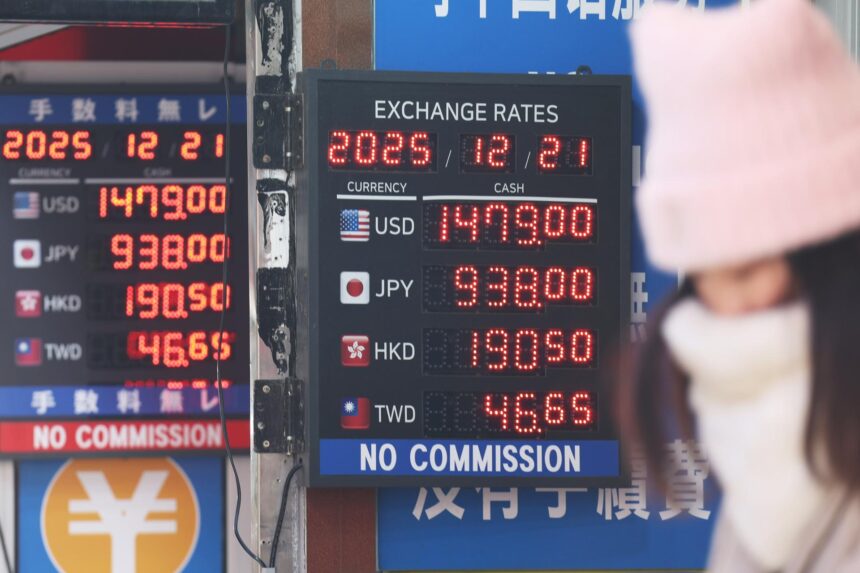
Exchange rates for the Korean won and other currencies were prominently displayed at a money booth in Seoul’s Myeong-dong shopping district recently, shedding light on the current volatility of the currency. Data reveals that the Korean won has ranked as the fifth-weakest currency in the world, a troubling situation that persists despite verbal interventions by financial authorities aimed at stabilizing its value.
According to the Bank of Korea, the won has experienced a noteworthy decline of 3.3 percent against the U.S. dollar in the fourth quarter. This decline positions the won as the fifth weakest among 42 tracked currencies, trailing behind notable currencies such as the Argentine peso, which fell by 6.8 percent, the Japanese yen at 5.1 percent, the Brazilian real at 3.7 percent, and the Taiwanese dollar, which matched the won’s 3.3 percent depreciation.
This drop in value has occurred even as financial authorities attempted to intervene verbally, leading to a temporary rebound that saw the won gain 33.8 won, reaching a close of 1,449.8 won during daytime trading—the strongest single-day rise in over three years. In the days prior, the exchange rate hovered in the 1,480-won range, marking a significant streak as it remained in this bracket for two consecutive days, the first such occurrence since the global financial crisis of 2009.
Throughout the fourth quarter, the U.S. dollar index, which measures the dollar’s strength against six major currencies, has fluctuated between 97 and 98. A reading above 100 suggests a strengthening dollar, while below that marks a weakening trend relative to other currencies, including the euro, yen, British pound, Canadian dollar, Swiss franc, and Swedish krona.
Analysts attribute the ongoing depreciation of the won to a blend of factors, including considerable net selling of domestic stocks by foreign investors, increasing overseas investments by the state-run National Pension Service (NPS), and a surge in derivatives trading, betting on a stronger dollar. Additionally, the purchasing power of the won has significantly decreased, highlighted by a report from the Bank for International Settlements indicating that the won’s real effective exchange rate index stood at 87.05 last month, marking the lowest rate since 2009.
The real effective exchange rate reflects a currency’s value against its main trading partners, adjusted for inflation and price variations. A figure below 100 signals undervaluation, which makes exports cheaper but inflates the cost of imports.
Experts indicate that the attempts by financial authorities to counteract the decline of the won have not yielded sufficiently strong results to reverse the trend of overseas investment. This year alone, the NPS has added approximately 70 trillion won to its overseas holdings, resulting in total foreign investments reaching 771 trillion won, which is approximately 58 percent of its assets. Simultaneously, retained earnings of South Korean corporations abroad surged by $7.8 billion—a 40.2 percent rise compared to last year. Individual investors also broke records with $32 billion in net purchases of U.S. stocks, a trend partially driven by the burgeoning artificial intelligence sector.
Economist Baek Seok-hyun from Shinhan Bank cautioned that until the domestic stock market becomes more attractive for investment, the depreciation of the won could persist in the long term. Woori Bank researcher Im Hwan-yeol echoed this sentiment, emphasizing the need for foreign exchange authorities to adopt a firmer stance in curbing the currency’s descent. He noted that the upward trajectory of the exchange rate might only stabilize once capital flows back into domestic stocks from the dollar.