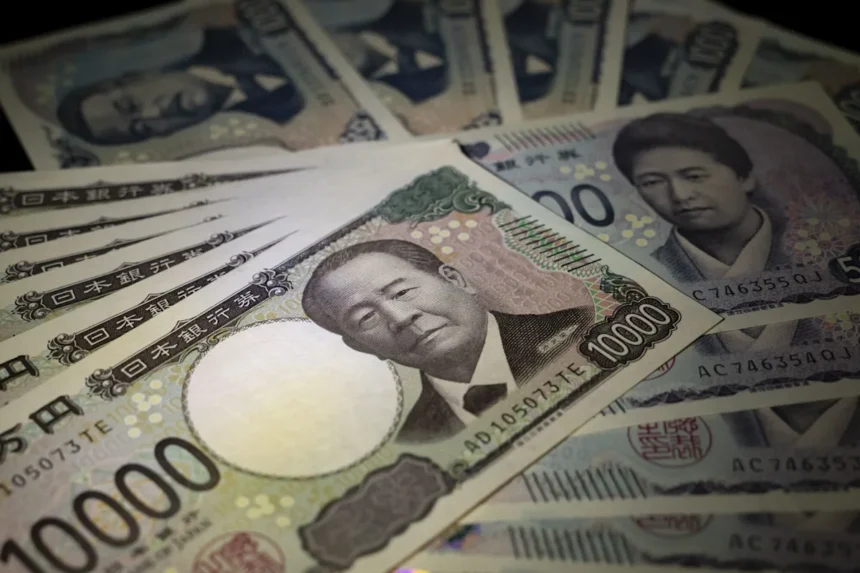
The bearish sentiment surrounding the Japanese yen is intensifying, following the Bank of Japan’s recent interest rate hike, which failed to provide a lasting boost to the currency. Analysts from major financial institutions such as JPMorgan Chase & Co. and BNP Paribas SA predict that the yen could slip to 160 per dollar or lower by the end of 2026. This outlook is fueled by prevailing conditions including significant yield disparities between the U.S. and Japan, negative real interest rates, and ongoing capital outflows.
Despite a modest gain of less than 1% against the U.S. dollar this year, following four consecutive years of declines, the yen’s hoped-for recovery has not materialized. After briefly strengthening past 140 per dollar in April, it faced renewed pressure amid uncertainty regarding U.S. trade policies, particularly under former President Donald Trump, and increasing fiscal risks due to domestic political dynamics in Japan. Currently, the yen is trading around 155.70, close to its annual low of 158.87 and roughly where it began the year.
Junya Tanase, chief Japan FX strategist at JPMorgan, commented on the currency’s weak fundamentals, asserting that there is little prospect for improvement into the next year. He expresses a cautionary stance as cyclical forces may further hinder the yen’s performance, particularly if markets begin to price in heightened interest rates elsewhere.
Market expectations reveal that the next interest rate increase from the Bank of Japan (BOJ) is not fully anticipated until September, with inflation consistently surpassing the central bank’s 2% target. This climate is intensifying pressure on Japanese government bonds. Additionally, carry trades—where investors borrow low-yielding currencies like the yen to invest in higher-yielding currencies—are re-emerging as a significant obstacle to the yen’s potential resurgence. Recent data indicates that leveraged funds are among the most bearish on the yen since July 2024.
The global economic landscape in the coming year is expected to support risk sentiment, a situation likely to bolster carry strategies. Parisha Saimbi, an EM Asia FX and rates strategist at BNP Paribas, forecasts that the dollar could rise to 160 against the yen by the end of 2026, attributing this to resilient carry demand and a cautiously approached BOJ.
Continued outward investment by Japanese individuals and institutions adds additional pressure on the yen. Retail investors’ net purchases of overseas stocks have maintained a strong pace, nearly reaching last year’s decade-high, reflecting a sustained preference for foreign assets. Meanwhile, the corporate sector remains engaged in steady foreign direct investments, with outward mergers and acquisitions achieving multi-year highs.
Tohru Sasaki, chief strategist at Fukuoka Financial Group Inc., highlighted that the absence of aggressive rate hikes from the BOJ, alongside deeply negative real interest rates, keeps the outlook grim. He predicts the dollar-yen pair could rise to 165 by the end of 2026, suggesting that if markets begin to factor in concluded rate cuts from the Fed, this could strengthen the pressure on the yen.
Despite the prevailing pessimism, some analysts hold a more optimistic long-term view. Goldman Sachs envisions the yen eventually appreciating towards 100 per dollar over the next decade, albeit acknowledging the present hurdles. The specter of potential government intervention is also back on the table, as recent observations note the yen’s value approaching levels that have historically prompted official action. However, analysts often argue that intervention may not suffice to reverse the yen’s current depreciative trajectory.
The market sentiment remains cautious and volatile, with experts noting that smooth operations alone may not be sufficient to alter the yen’s decline. The immediate focus is directed toward the government’s upcoming fiscal strategy, which could play a crucial role in shaping the currency’s future performance.