Japan’s Cabinet has approved an unprecedented defense budget exceeding 9 trillion yen (approximately $58 billion) for the upcoming fiscal year, marking a 9.4% increase from the previous year. This budget is part of a five-year plan aimed at doubling Japan’s annual arms spending to 2% of its gross domestic product (GDP), reflecting the country’s heightened focus on military capabilities amid escalating regional tensions.
The new budget is set to further bolster Japan’s strike-back capability and coastal defenses as concerns regarding China’s military actions intensify. Prime Minister Sanae Takaichi, earlier this year, indicated that Japan’s Self-Defense Force could engage militarily should China act against Taiwan, which it views as a breakaway province. Under U.S. pressure to enhance its military readiness, Takaichi’s government pledged to achieve the 2% GDP target by March, two years ahead of the original schedule.
In a significant departure from its post-World War II military stance, Japan plans to enhance its offensive capabilities with long-range missiles and unmanned systems for defense. The current security strategy identifies China as Japan’s primary strategic challenge, leading Tokyo to articulate a more proactive military role in conjunction with its U.S. security alliance.
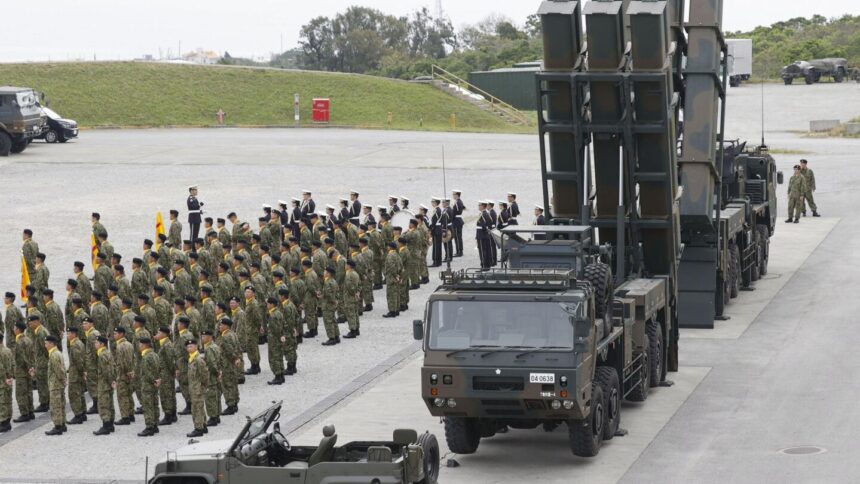
Among the key allocations in the new budget, over 970 billion yen ($6.2 billion) will be directed towards enhancing Japan’s “standoff” missile capabilities. This includes a purchase of 177 billion yen ($1.13 billion) worth of domestically developed Type-12 surface-to-ship missiles, which boast a range of around 1,000 kilometers (620 miles). The initial deployment of these missiles is expected in Japan’s Kumamoto prefecture by March, a year earlier than originally planned.
The government recognizes the necessity of incorporating unmanned systems due to the challenges posed by an aging population and a military workforce that is stretched thin. An allocation of 100 billion yen ($640 million) is dedicated to the development of a “massive” array of unmanned air, sea, and underwater drones intended for surveillance and coastal defense under a program known as “SHIELD,” scheduled for launch by March 2028. Initial deployments may rely on foreign technology, potentially from countries like Turkey or Israel.
Heightened tensions with China have become evident, especially in light of Takaichi’s comments about potential military involvement over Taiwan. A recent incident involving Chinese drills near Japan, where Chinese aircraft locked radars on Japanese planes, has further escalated diplomatic friction. In response, Japan is establishing a new office dedicated to monitoring and analyzing Chinese military activities in the Pacific.
As part of its strategy to build a robust domestic defense industry, Japan is also pursuing joint development projects with allied nations. For the fiscal year 2026, the budget includes more than 160 billion yen ($1 billion) earmarked for collaboration with the UK and Italy on a next-generation fighter jet expected to be operational by 2035. Additionally, research into AI-operated drones is underway to complement this new aircraft.
As Japan aims to increase its military spending significantly, funding strategies involve raising corporate and tobacco taxes alongside plans for an income tax increase set to commence in 2027. However, questions remain about the sustainability of such growth relative to GDP in the future.
This defense budget plan now awaits parliamentary approval by March as part of a broader national budget bill totaling 122.3 trillion yen ($784 billion). If passed, it would position Japan as the world’s third-largest military spender after the U.S. and China, with the government confident in meeting its 2% target ahead of schedule.