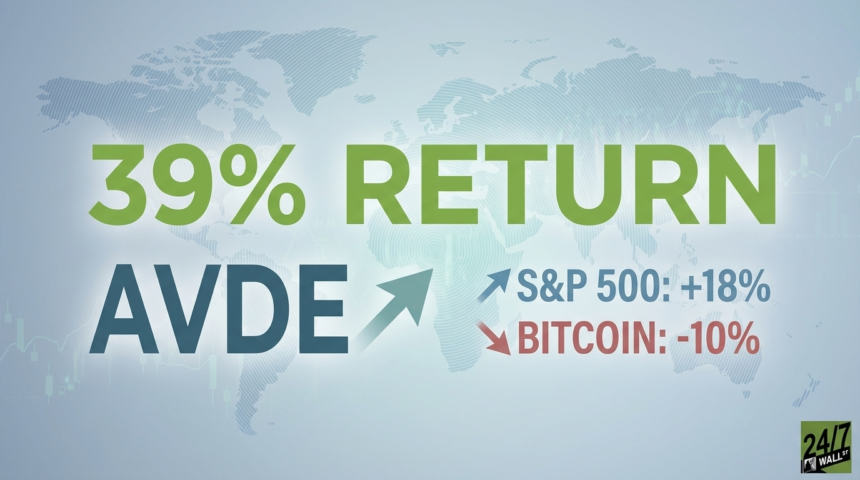
While most investors have been fixated on the performance of the S&P 500 and Bitcoin in 2025, an unexpected contender, the Avantis International Equity ETF (AVDE), has emerged as a standout performer with an impressive 39% return. This accomplishment is particularly noteworthy when considering Bitcoin’s decline from a starting value of $96,525 to $87,291, marking a nearly 10% drop, and the S&P 500’s more modest gain of 18%.
The remarkable performance of AVDE highlights a significant shift in the relative performance of international markets compared to U.S. equities. The widely recognized iShares MSCI EAFE ETF, which serves as a benchmark for international stocks, has also seen positive returns, rising 32%. However, AVDE’s active management strategy has delivered approximately 7 percentage points of alpha over this passive exposure.
Several key factors contributed to the strong showing of international markets. A stabilization in the European economy, coupled with higher interest rates, created a lucrative environment for financial stocks. The Avantis ETF has large holdings in prominent European banks such as HSBC, UBS, Barclays, and Deutsche Bank, which capitalized on extended elevated rates from the European Central Bank. As a result, the STOXX Europe 600 Banks Index saw a significant surge of 65% for the year.
In addition to financials, heightened defense spending amid ongoing geopolitical tensions provided another boost. Notably, major European defense contractors like Rheinmetall, Safran, and Rolls-Royce experienced substantial order backlogs, contributing to a nearly 60% increase in the European defense sector in 2025. AVDE’s strategic positions in these companies allowed it to capture a significant portion of this growth.
Currency movements have also played a crucial role. A weakening of the dollar against both the euro and the pound throughout much of 2025 resulted in translation gains for U.S. investors holding international equities. Consequently, strong local currency returns were further amplified by favorable exchange rates.
AVDE distinguishes itself from many other funds through its active management style, which adopts factor tilts toward value, profitability, and smaller companies within developed international markets. This tactical approach has led the fund to overweight sectors like financials and industrials while remaining underweight in mega-cap technology stocks. Its portfolio features an extremely high level of diversification, with no single stock exceeding 1% of its holdings and cash representing only 1.19%. This strategic positioning minimizes concentration risk while enabling exposure to prevailing market trends.
With an expense ratio of 0.23%, AVDE offers remarkably low costs for actively managed funds. Its portfolio turnover is impressively low at just 3%, enhancing tax efficiency, and it provides investors with a dividend yield of 2.37%, delivering income while they await potential capital appreciation.
Looking ahead, a crucial macroeconomic factor for 2026 will be the performance of the dollar. If the Federal Reserve implements more aggressive rate cuts than European central banks, continued weakness in the dollar could push international equities to outperform for longer periods. Investors are advised to closely monitor the DXY dollar index and policy statements from the European Central Bank, as any disparity in monetary policy will have direct implications for AVDE’s returns.
Moreover, tracking AVDE’s monthly fact sheets will provide insights into sector rotations. If management begins to shift from financials or defense into other sectors, it may indicate a changing outlook on where value lies. The fund consistently rebalances its portfolio based on profitability and valuation metrics, making its holdings shifts a valuable signal for assessing relative investment opportunities.
For those seeking alternative investment strategies with similar international exposure, the iShares MSCI EAFE Value ETF represents a potential option. This fund, offering a purer value tilt and an expense ratio of 0.30%, is slightly lower in costs and focuses on $7.6 billion in assets. While it lacks the active management and small-cap exposure that define AVDE, it allows for a more concentrated investment in international value stocks and may provide better liquidity for larger holdings.
Ultimately, the key determinant for AVDE in 2026 will be whether European economic growth can sustain elevated profitability in the banking sector, while the critical micro signal to watch will be whether the fund maintains its overweight position in financials or begins to diversify into other sectors.