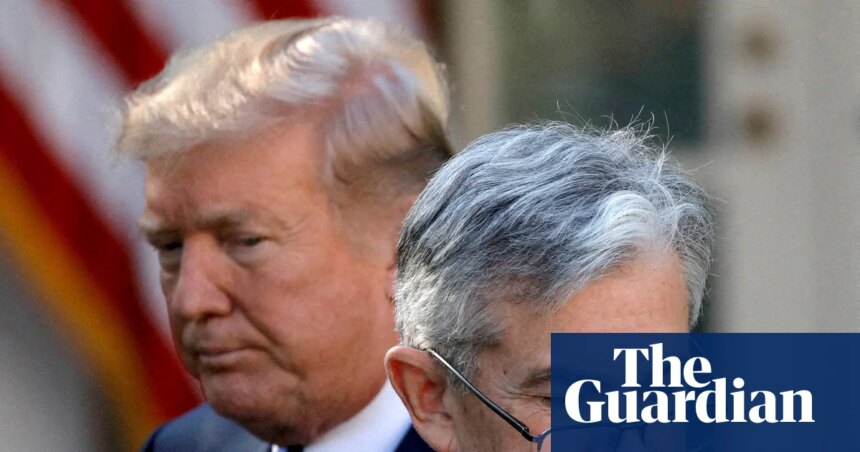
During a recent press conference alongside Israeli Prime Minister Benjamin Netanyahu, former President Donald Trump sharply criticized Federal Reserve Chair Jerome Powell, labeling him a “fool” and suggesting potential legal action against him for what Trump termed “gross incompetence.”
Repeating his long-standing claims regarding the costs associated with the renovation of the Federal Reserve headquarters, Trump claimed that expenditures had soared to $4.1 billion, despite the actual figure being significantly lower at approximately $2.5 billion. This exaggerated assessment drew a stark response from Powell, who previously addressed the cost discrepancy in a public setting.
Trump’s comments came amid assertions about the state of the U.S. economy, which he heralded as strong despite what he termed Powell’s shortcomings. “Biden reappointed him. It’s too bad. You would have thought he wouldn’t have done that,” he remarked, neglecting to mention that he had appointed Powell in 2018.
In discussing the Federal Reserve’s renovation project, Trump expressed disdain for the expenditures, comparing them unfavorably to other construction projects, including a ballroom he claimed to be building at the White House. He boasted that the ballroom project, which is estimated to cost $400 million, would come in at “a tiny fraction” of the alleged Federal Reserve costs. This statement, however, was immediately followed by a contradiction, as he admitted that the current ballroom estimate had doubled from earlier projections of $200 million.
Trump attributed the ballooning cost of the ballroom to necessary security upgrades for an upcoming inauguration. “All bullet-proof glass” and a “drone-free roof” were highlighted as factors contributing to the increased budget, emphasizing new safety measures.
In commenting on his potential successors for Powell’s position, Trump indicated that he would announce his choice in January, reinforcing that he would have the opportunity to shape Federal Reserve leadership in the near future. His remarks signal a continued interest in economic policy and oversight, even as he expresses dissatisfaction with current leadership at the Fed.