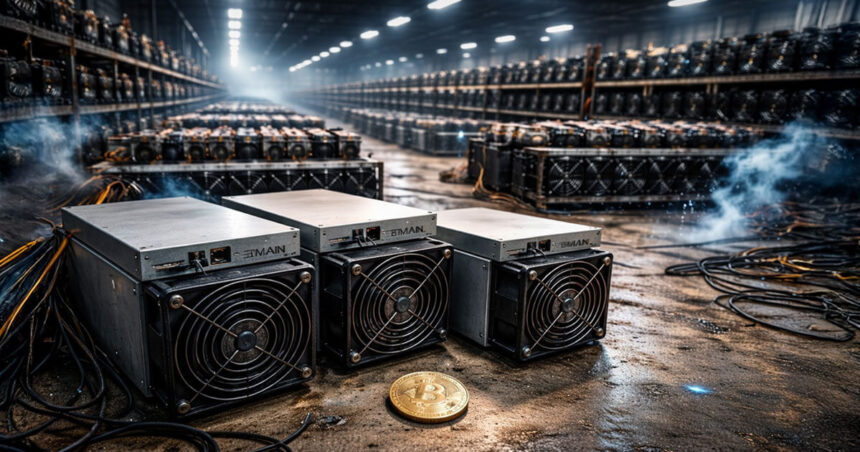
Bitmain has announced a price reduction for its Bitcoin mining rigs, effective December 23, driven by decreased miner revenue per unit of hashrate observed in November. This decision comes during a challenging market period where Bitcoin’s price gains have not resulted in the mining-margin improvements typically associated with hardware shortages and swift price escalations.
The current market capitalization of Bitcoin stands at approximately $1.74 trillion, with a 24-hour trading volume of $47.27 billion. Bitcoin reached an all-time high of $126,173.18, showcasing significant volatility. Recent pricing data indicates that a container bundle for the S19 XP+ Hydro model, which has a performance of around 19 J/TH, is currently offered at about $4/TH, with shipping set to start in January 2026. Internal price lists reveal even lower quotes, with some models priced as low as $3/TH for certain S19 Hydro variants and around $7 to $8/TH for the newer S21 immersion or hydro models prior to discounts.
Alongside these discounts, Bitmain is offering hosting packages, which provide power rates between 5.5 to 7 cents per kilowatt-hour, plus an additional management fee of approximately 0.3 cents, across various locations. The struggling hashprice for November 2025 averaged $39.82 per PH per day, with November 22 marking a new low at $35.06 per PH per day. These figures reflect ongoing shifts in miner economics, which have significantly impacted demand for ASIC hardware.
The decline in hashprice indicates that profitability is becoming harder to achieve, as miners are faced with compressed revenues. Analysis from Luxor highlights that the daily income per PH, calculated to roughly $0.040/TH/day, translates into significant operational costs. For instance, a 200 TH/s rig would yield about $8 daily, with electricity expenses estimated at roughly $5.47 based on a midpoint hosting price of $0.06/kWh. This leaves a meager margin of $2.53 per day, before accounting for additional expenses such as facility fees and maintenance.
The current payback period for hardware investment is thus elongated, with miners often needing to underwrite nearly a year of operation costs, affecting the market dynamics for rig pricing. The historical landscape shows stark contrasts; for instance, hardware that sold for approximately $105/TH in November 2021 is now priced around $12/TH by March 2024, despite fluctuations in Bitcoin’s value during this timeframe.
The prevailing economic context has prompted a radical shift in sales strategies, with manufacturers, including Bitmain, bundling hosting services with hardware sales. This transition from a singular capital expenditure model to a comprehensive operational model for miners emphasizes the importance of power procurement and facility operations in the current landscape where consistent access to energy at reliable prices is becoming increasingly critical.
Moreover, outside factors are contributing to lower demand for ASIC expansions. Miners are diversifying by repositioning data centers for artificial intelligence and high-performance computing, gaining investor favor for such strategies. The market has shown a stronger interest in miners branching into AI-related ventures, reflecting a shift in capital allocation trends away from exclusively Bitcoin mining.
Looking ahead, forward pricing in the hashprice market has exhibited a cautious outlook, highlighting pressures on near-term mining profitability. Luxor’s recent evaluations indicate a notable decline in USD-denominated forward hashprices, even as Bitcoin-denominated futures have shown a rise. This divergence poses challenges for operators, as they are primarily concerned with US dollar cash flow when covering operational costs.
Bitmain’s strategy to test interest in discounted bundles through a January 2026 shipping window raises questions about the future demand for ASIC models priced below $10/TH, particularly as the hashprice fluctuates between $35 to $50 per PH per day. The outcome of this initiative may offer insights into the evolving landscape of Bitcoin mining economics and the long-term viability of specific operational strategies.