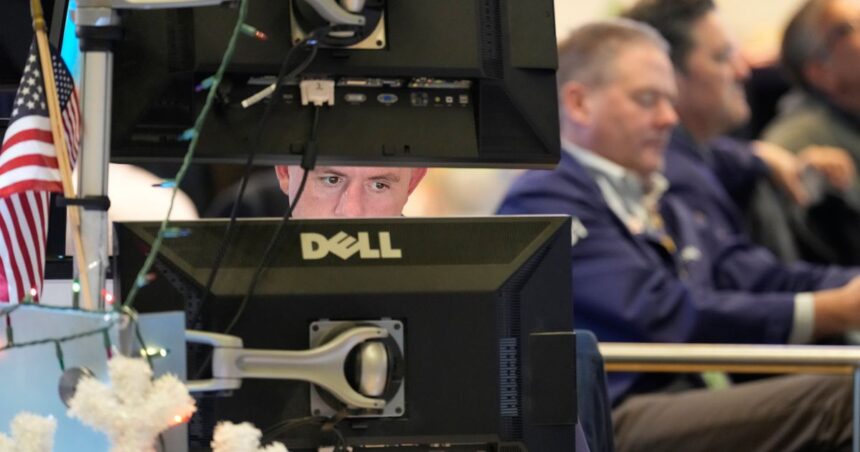
U.S. stocks are experiencing a slight decline in early trading as Wall Street nears the end of a remarkable year marked by both optimism and uncertainty. As of 10:07 a.m. Eastern Time, the S&P 500 is down 0.2%, the Dow Jones Industrial Average has decreased by 111 points (also a 0.2% drop), and the Nasdaq composite is down 0.2%. This comes after three consecutive days of losses for the stock indexes.
The trading atmosphere is notably light ahead of the impending New Year’s Day holiday, with markets scheduled to close. With only one trading day remaining in the year, many large investors have already finalized their positions, contributing to thinner trading volumes.
Despite the recent pullback since Christmas, the major indexes are positioned to finish the year with significant gains. The S&P 500 has risen over 17% throughout the year, marking its third consecutive year of double-digit growth. The Nasdaq has surged by 21.3%, while the Dow has experienced a 13.7% increase.
These gains have largely been driven by investor enthusiasm for artificial intelligence and its potential to enhance profitability across various sectors. However, the market has navigated through its share of turbulence, including the tumultuous trade policies of former President Donald Trump, as well as uncertainties regarding the future of interest rates.
In April, the S&P 500 suffered its worst single-day loss since the COVID-19 pandemic, plummeting nearly 5% on April 3, followed by an additional 6% drop the next day, ignited by fears of an escalating trade war with China. Concerns also permeated the U.S. Treasury market during this period. Trump later opted to pause the tariffs and pursued negotiations to reduce rates on imported goods, which alleviated some investor apprehension.
Strong corporate profit reports alongside three interest rate cuts by the Federal Reserve provided further momentum for market gains. Nonetheless, the excitement surrounding AI in 2025 has been tempered by skepticism over whether this technology will yield sufficient profits and productivity to justify the vast investments, potentially casting a shadow over AI stocks like Nvidia and Broadcom that have heavily influenced market upside.
The perceived overvaluation of stocks is another area of concern, as prices have escalated more rapidly than profits across the board. Coupling these worries with the ongoing repercussions of a U.S.-led trade war, inflation levels in the U.S. are anticipated to intensify. Despite efforts by the Federal Reserve to lower rates amid labor market concerns, inflation remains well above the central bank’s target of 2%.
Market participants are betting on the Fed maintaining steady interest rates at its upcoming meeting in January. On Wednesday, the Labor Department provided an update indicating a decrease in unemployment benefit applications, despite reports of a cooling labor market and low layoffs.
Technology and communication services sectors are among the most significant detractors in the market today. Notably, Broadcom declined by 1.1%, and Micron Technology saw a 2% decrease.
In the bond market, Treasury yields are predominantly on the rise, with the 10-year Treasury yield climbing to 4.14% from 4.13% late Tuesday. The two-year Treasury yield, which aligns closely with Federal Reserve expectations, increased to 3.46% from 3.45%.
Trading in precious metals has been volatile as the year comes to a close. Silver experienced a significant loss, dropping more than 6% after a prior gain of over 10%. Following a remarkable 7.7% surge on Friday, silver’s value plummeted nearly 9% on Monday, although it remains up more than 140% for the year. Meanwhile, gold is down 0.6% but maintains a year-to-date increase of 65%.
Global markets, including those in Germany, Japan, and South Korea, are closed for the New Year’s holidays, while mixed trading occurs in remaining markets. In commodities, U.S. crude oil gained 39 cents, reaching $58.34 per barrel, while Brent crude, the international benchmark, increased by 36 cents to $61.69 per barrel.