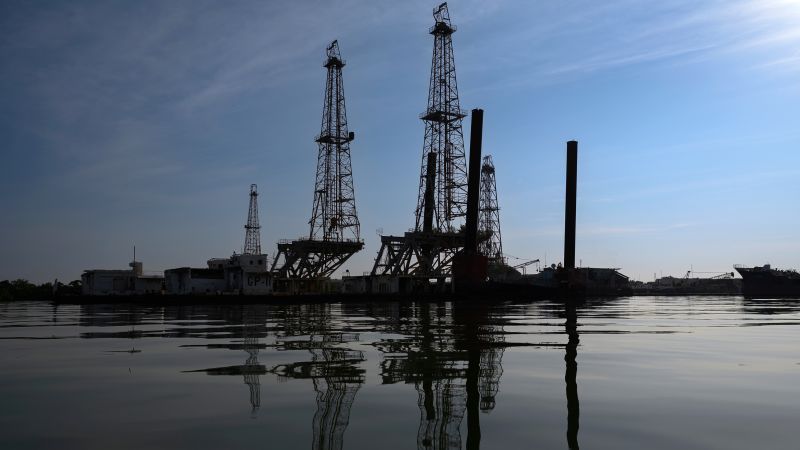
Venezuelan President Nicolás Maduro has been captured and removed from the country following a significant US military strike on the nation’s capital, Caracas. This development has sparked uncertainty regarding the political landscape of Venezuela, particularly because of its vast oil reserves.
Venezuela is home to approximately 303 billion barrels of crude oil, making it possess more oil than Iraq. This accounts for about one-fifth of the world’s total proven oil reserves, as highlighted by the US Energy Information Administration. The fate of these resources will be a pivotal aspect of Venezuela’s future.
The impact of the military action on oil prices remains uncertain, especially since oil futures do not trade during the weekend. Analysts suggest the coming days will be crucial in determining the market’s response. Maduro’s government has previously been perceived as hostile towards the global oil industry, leading to a deterioration of the nation’s oil infrastructure. The question remains whether a new government would maintain tight control over this vital sector or adopt a more market-friendly approach.
Phil Flynn, a senior market analyst at Price Futures Group, commented on the critical nature of this event for the oil market, emphasizing how both the Maduro regime and Hugo Chavez had previously marginalized Venezuela’s oil production capabilities.
Following Maduro’s capture, US Secretary of State Marco Rubio announced the resolution of US operations in Venezuela, although it is unclear who will take charge next. The current Vice President, Delcy Rodríguez, represents the socialist faction that has governed since 1999. If she were to assume power, many anticipate that little would change immediately.
Maduro’s ousting has created a possible power vacuum, raising questions about the stability of Venezuelan politics. The United States recognizes exiled leader Edmundo Gonzalez as the legitimate president, supported by notable figures such as 2025 Nobel Peace Prize recipient María Corina Machado.
Flynn noted that the next 24 to 48 hours are critical. Signs of military support for the opposition could boost global market confidence, while any indicators of escalating conflict or civil discord could have the opposite effect.
Despite its vast reserves, Venezuela’s actual oil production has drastically declined, now standing at about 1 million barrels per day—roughly 0.8% of global crude output. This is a stark drop from the 3.5 million barrels produced prior to Maduro’s leadership in 2013. Factors contributing to this decline include international sanctions, economic turmoil, and a lack of investment and maintenance on vital oil infrastructure.
Even if Venezuela’s oil supply faces major disruptions in the wake of military actions, analysts believe that prices will not soar excessively. The nation’s current output is insufficient to significantly influence global prices, which have remained stable this year amid concerns of oversupply, particularly with OPEC increasing production despite a slight decrease in global demand due to inflation challenges.
The oil price briefly climbed above $60 per barrel when US actions targeting Venezuelan oil vessels commenced, but it has since returned to around $57 per barrel. While there might be a psychological boost in the market, the expectation is that the oil lost from Venezuela could be compensated by other global producers.
Venezuela’s crude is classified as heavy and sour, necessitating advanced equipment and expertise for effective extraction and refinement. Although international oil companies possess the necessary technologies, sanctions have barred them from engaging with Venezuela’s oil markets.
For the US, tapping into Venezuelan oil could have significant benefits: its proximity and lower cost of extraction, despite being heavy and sludgy. Many US refineries are optimized for processing Venezuela’s oil, making them more efficient compared to lighter American crude.
Flynn remarked that if the situation progresses positively, it could allow US companies to return and revitalize Venezuela’s oil sector, potentially transforming the global oil market landscape.