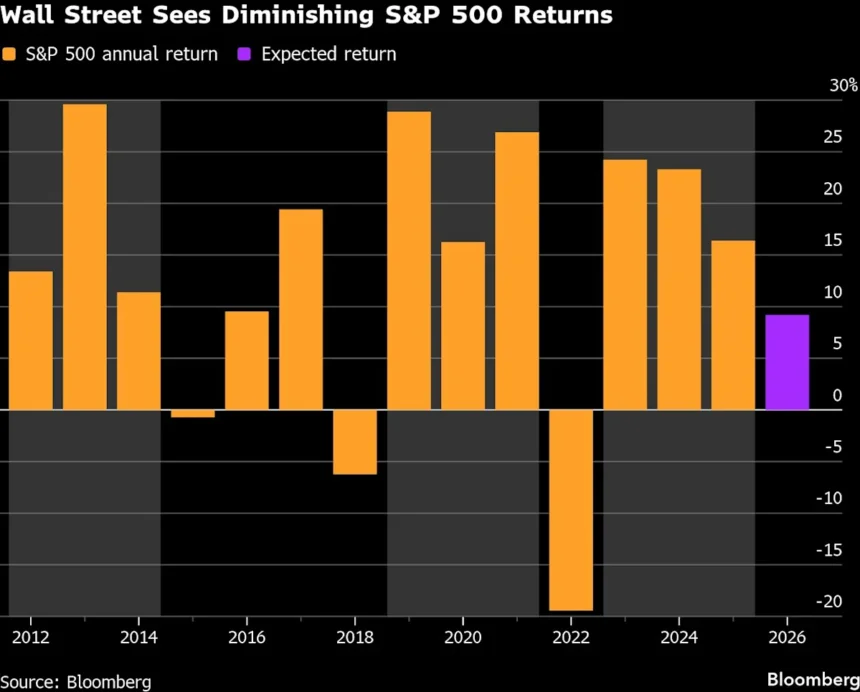
An impressive three-year surge that has seen US equities climb by 78% hasn’t dampened Wall Street’s optimistic outlook. However, the prevailing enthusiasm is tinged with caution as experts suggest a tempered approach for this year.
Sam Stovall, chief investment strategist at CFRA, emphasized the need for slightly lowered expectations in a recent comment. “It’s OK to remain a bull but spell it with a lower-case B because we’re also bumping up against a historically challenging mid-term election year,” he said.
Strategists surveyed by Bloomberg project a 9.2% gain for the S&P 500 this year, which aligns with the average total return over the past two decades. Nonetheless, this forecast falls short of the previous years, where the index experienced rallies of 24%, 23%, and 16%. Stovall indicated that the anticipated average gain matches historical trends for the fourth year following three consecutive years of double-digit returns.
Despite this, recent market history raises caution. The last two instances of back-to-back gains exceeding 10% were followed by annual declines in both 2020 and 2015. Should the S&P 500 achieve a 10% gain this year, it would represent the strongest four-year performance for the index since 1999.
The bullish outlook hinges on expectations of a robust US economy in the first half of the year, bolstered by tax cuts, regulatory easing, and a significant boost from advancements in artificial intelligence. However, analysts express concern over persistent high valuations and the potential impact of capital spending on profit levels.
BofA Securities strategists Victoria Roloff and Savita Subramanian noted in a recent research piece that the increasing capital intensity of major tech companies, elevated price multiples, and emerging cracks in the labor market necessitate a more cautious stance. They predict a modest 4% increase for the S&P 500 this year.
Market history also suggests caution as the average gain during mid-term election years is merely 3.8%, with the market rising just 55% of the time. Stovall pointed out that this is not much better than a coin flip.
Tom Essaye, founder of Sevens Report, highlighted that a three-year stock rally like the recent one often precedes cyclical bear markets. He described the current scenario as particularly “ominous,” referencing negative five-year forward returns for the S&P 500 following similar past performances. Essaye noted emerging signs of a bear market, citing concerns about potential bubbles in AI stocks and recent drops in the benchmark testing critical support levels.
Despite warnings regarding high valuations and unsustainable share-price escalations, the stock market has benefited from robust corporate profits. Earnings growth is projected to accelerate significantly in 2026, reaching nearly 14% compared to 12% in 2025, potentially providing a tailwind for the market.
Keith Lerner, chief investment officer and market strategist at Truist Advisory Services Inc., remarked on the earnings-driven nature of the current bull market, stating that while there has been a modest uptick in valuations, the primary driver has been earnings. He acknowledged the expectation of earnings continuing to bolster market performance but also noted the likelihood of lower appreciation rates given the elevated multiples stocks are trading at. “After three years of gains, you could see some modestly lower returns but still positive over the next year,” Lerner concluded.