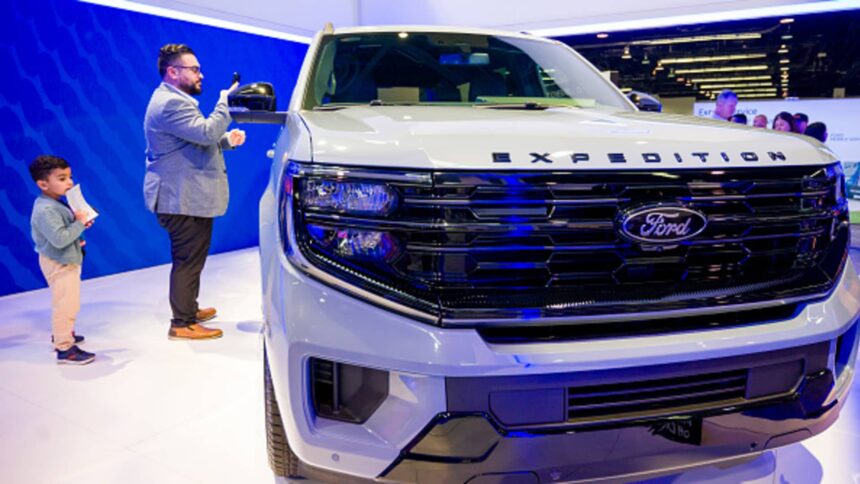
Visitors flocked to the OC Auto Show held at the Anaheim Convention Center on October 3, 2024, to witness the unveiling of the new Ford Expedition, highlighting the automaker’s efforts to captivate consumers with its latest offerings. Meanwhile, in an announcement from Detroit, Ford Motor Company revealed impressive sales figures for the previous year, marking a significant rebound in its performance.
The company reported a 6% increase in U.S. vehicle sales, achieving its best annual total since 2019, with a notable 2.2 million vehicles sold in 2025. This includes a 2.7% rise in sales during the fourth quarter, amounting to more than 545,200 units. In a comparison of annual performance, Ford’s sales in 2019 reached 2.42 million vehicles.
Finishing the year as the third-largest automaker in the United States, Ford trailed only behind Toyota Motor and General Motors, the latter being the leader in domestic sales. Analyst forecasts, including those from Cox Automotive, anticipated a trend consistent with Ford’s results, predicting a modest industry-wide sales increase of about 2% to a total of 16.3 million units for 2025.
Andrew Frick, president of Ford’s non-fleet vehicle businesses, expressed satisfaction with the company’s yearly outcome, noting, “We’re really pleased with where we finished the year.” He highlighted that Ford outperformed the industry for ten consecutive months, showcasing the strength of its sales performance as the year progressed.
However, the fourth-quarter results reflected ongoing production challenges, particularly with Ford’s F-Series pickup trucks. The automaker faced setbacks due to two separate fires at a New York plant that supplies key aluminum materials. Despite these hurdles, Frick expressed optimism, stating that the company is “on track” to recover from the lost production of tens of thousands of pickup trucks by adding an additional shift at a Michigan plant.
Sales of the F-Series, which includes the widely popular F-150 model, experienced an 8.3% increase over the year, although sales dipped by 3.1% in the fourth quarter. Alongside this, Ford has been navigating a decline in its electric vehicle (EV) market, witnessing a drop of 14.1% overall for the year, with a staggering 52% decrease in the fourth quarter alone. In contrast, the sales of Ford’s hybrid vehicles showed a positive trend, increasing by nearly 22%, helping mitigate the losses from the EV segment.
The majority of Ford’s sales, around 86%, continued to come from traditional vehicles powered by internal combustion engines, underscoring the ongoing preference for these models among consumers as the automaker navigates the evolving automotive landscape.