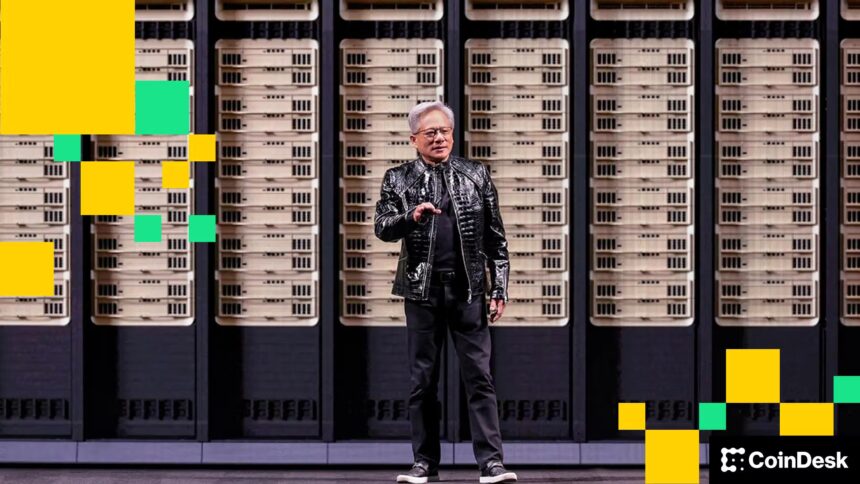
At the CES tech event in Las Vegas, Nvidia CEO Jensen Huang introduced details about the company’s highly anticipated Vera Rubin platform. According to Huang, the next-generation hardware is currently in “full production” and is set to revolutionize artificial intelligence computing by delivering five times the performance of Nvidia’s previous systems. Expected to launch later this year, the Rubin platform aims to become a cornerstone in the rapidly expanding AI market, focusing on efficiently delivering outputs from trained models.
The flagship server of the Rubin platform boasts an impressive configuration with 72 graphics processing units (GPUs) and 36 central processors, allowing for significant computational power. Moreover, these servers can be interconnected into larger “pods,” each containing over 1,000 Rubin chips, providing unparalleled scalability for AI applications.
Efficiency was a major theme of Huang’s presentation, particularly regarding the generation of AI “tokens,” the fundamental elements produced by language models. He noted that Rubin systems could enhance efficiency by a staggering tenfold, facilitated by a proprietary data type that Nvidia encourages the industry to adopt. This significant performance improvement has been achieved with only a modest 1.6 times increase in transistor count, indicating a leap forward in engineering prowess.
Huang characterized the ongoing development in AI as a competitive race, where speed of processing is crucial for reaching new milestones quicker than rivals. This competitive landscape drives companies to invest heavily in chips, networking infrastructure, and storage solutions.
The ripple effects of this AI infrastructure race are also significantly impacting the cryptocurrency market, particularly bitcoin mining. Miners are pivoting to position themselves as infrastructure providers, focusing on their energy contracts, cooling systems, and data-center capabilities to attract AI workloads. Hosting AI applications is proving to be a more stable source of revenue compared to the volatility of bitcoin mining, especially for operators that have access to affordable power and existing facilities.
However, this shift has also increased competition for data-center space, now considered a premium asset. Hyperscalers, cloud computing firms, and startups in the AI space are driving up the demand, consequently elevating rents, equipment costs, and financing challenges for smaller miners. The landscape suggests that those miners who effectively frame their operations as infrastructure businesses may find greater success, while those solely reliant on mining profits could face challenges in the coming years.
In addition to the Rubin platform, Nvidia unveiled new networking switches that utilize a cutting-edge connection method known as co-packaged optics. This technology is essential for linking thousands of machines into cohesive systems, further enhancing the capabilities of AI applications.
CoreWeave is expected to be among the first to implement the Rubin systems, with major companies like Microsoft, Oracle, Amazon, and Alphabet also anticipated to adopt this innovative hardware. As the demand for efficient AI computing surges, Nvidia’s advancements may significantly reshape both the AI and cryptocurrency landscapes in the near future.