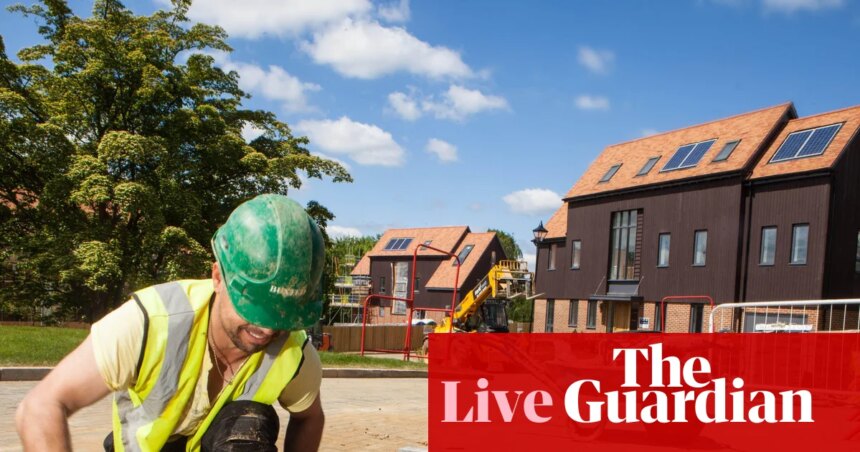
The UK construction sector faced significant challenges in December, continuing its downward spiral due to declining activity in housebuilding, commercial, and civil engineering. According to a report from S&P Global, both overall construction activity and new orders experienced sharp declines, marking the deepest slump since May 2020, when the Covid-19 pandemic forced the closure of building sites.
The survey of purchasing managers from UK construction firms revealed that housebuilding and commercial construction fell at their fastest rates in over two and a half years. This prolonged contraction underscores the government’s difficulties in meeting its housing targets, with civil engineering marking the weakest segment of construction, experiencing a milder decline than in the previous month.
Despite a slight uptick in the UK’s construction Purchasing Managers’ Index (PMI), which rose to 40.1 from 39.4, the index continues to highlight stark sector contraction, with a reading below 50 indicating ongoing downturn. This marks the 12th consecutive month of decline, positioning it as the longest streak since the global financial crisis of 2007-09.
The S&P report attributes the downturn to fragile client confidence and delayed investment decisions ahead of the November Budget, which negatively impacted workloads. However, there are hints of optimism, as business activity expectations for the forthcoming year rebounded to a five-month high, suggesting that uncertainty around the Budget may be easing.
Tim Moore, economics director at S&P Global Market Intelligence, emphasized the challenging conditions faced by construction firms, noting the subdued demand and cautious client confidence. He acknowledged that while the speed of the downturn had moderated since November’s acute slowdown, the overall business activity remained weak as delayed spending decisions continued to plague sales pipelines.
As the construction sector struggles, attention has turned toward the broader economic landscape. Recent government bond auctions indicated strong demand for UK debt, attracting bids three and a half times the available amount, the highest since July. Higher interest rates offered by UK government bonds have made them appealing to investors compared to other sovereign debts.
The economic outlook remains uncertain, with predictions of interest rate cuts by the Bank of England potentially providing some relief for construction activity by encouraging borrowing. Analysts anticipate that declining unemployment and easing inflation might also foster a more favorable environment for the sector, though skepticism remains regarding the pace of future recovery.
Industry experts express mixed sentiments about the construction sector’s prospects moving into 2026. While some highlight potential improvements due to infrastructure investment, others warn that the capacity to meet increased demand could be challenged by ongoing labor availability issues.
In summary, the UK construction sector is currently weathering a significant downturn characterized by reduced activity across various segments. Although there are faint signs of recovery, the path ahead remains fraught with uncertainty, influenced by external economic factors and internal industry dynamics.