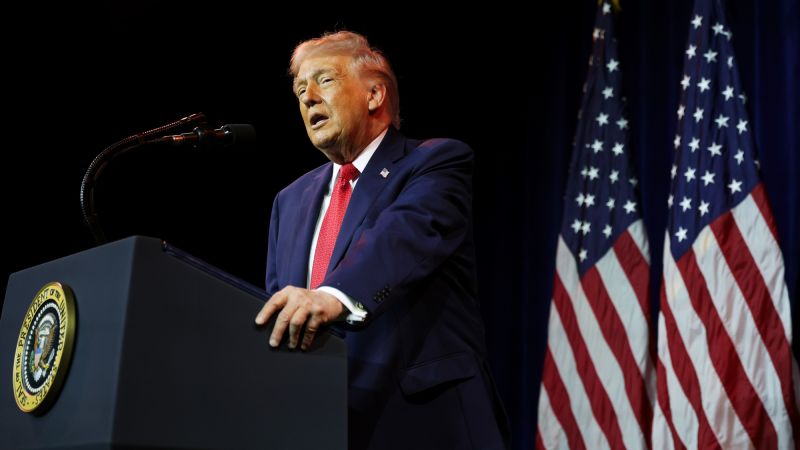
In a significant move aimed at addressing the affordable housing crisis, President Donald Trump announced plans on Wednesday to prohibit large institutional investors from purchasing additional single-family homes. Through a post on social media, Trump emphasized, “I am immediately taking steps to ban large institutional investors from buying more single-family homes, and I will be calling on Congress to codify it. People live in homes, not corporations.”
This announcement comes as a response to the rising trend of institutional entities, including major firms like Blackstone and JPMorgan Chase, buying up family homes in recent years. These investors have increasingly turned to residential properties in pursuit of higher returns amidst soaring home prices. Their activity has notably surged since the foreclosure crisis of 2008, particularly in markets across the Sun Belt states, where housing demand has been robust.
Following Trump’s statement, shares of Blackstone plummeted by as much as 9% on the stock market, revealing investor concern over potential policy shifts that could affect the company’s real estate investments.
The president indicated plans to unveil further proposals aimed at increasing housing affordability in the weeks ahead. He remarked, “I will discuss this topic, including further Housing and Affordability proposals, and more, at my speech in Davos in two weeks,” where he is scheduled to speak at the upcoming World Economic Forum.
The U.S. housing market has experienced significant challenges, reflected in escalating buying costs. Factors contributing to this crisis include a stagnant inventory of homes and mortgage rates surpassing 6%, which have constrained many prospective buyers. Additionally, many existing homeowners are reluctant to sell and lose the ultra-low mortgage rates secured during the pandemic when interest rates were near zero.
Recent reports from the National Association of Home Builders reveal that from the onset of 2020 to the third quarter of 2025, home prices have skyrocketed nearly 55% nationwide. A Government Accountability Office report highlighted the rapid evolution of institutional investment in residential real estate, noting that in 2011, no investor owned 1,000 or more single-family rental homes; by 2015, that number had risen to 300,000 homes.
In specific metropolitan areas like Atlanta, Jacksonville, and Charlotte, institutional investors controlled over 15% of the single-family home market as of 2022, raising alarm among lawmakers concerned about the impact of such corporate buying on local markets.
While bipartisan discussions have emerged around restricting certain corporate investments in housing, experts in the real estate field have expressed skepticism regarding the effectiveness of a ban. Critics argue that such a measure may not provide a meaningful solution to the underlying housing affordability issues. Jaret Seiberg, an analyst at TD Cowen, cautioned in a recent note, “This will not fix housing affordability. It may boost single-family purchases, but it will come at the cost of reducing single-family rentals,” highlighting the complexities of the housing market and the risks involved in altering investment dynamics.
As discussions about housing policy continue, the interplay between institutional investment and residential affordability remains a contentious issue crucial to American families seeking stability in a challenging economic landscape.