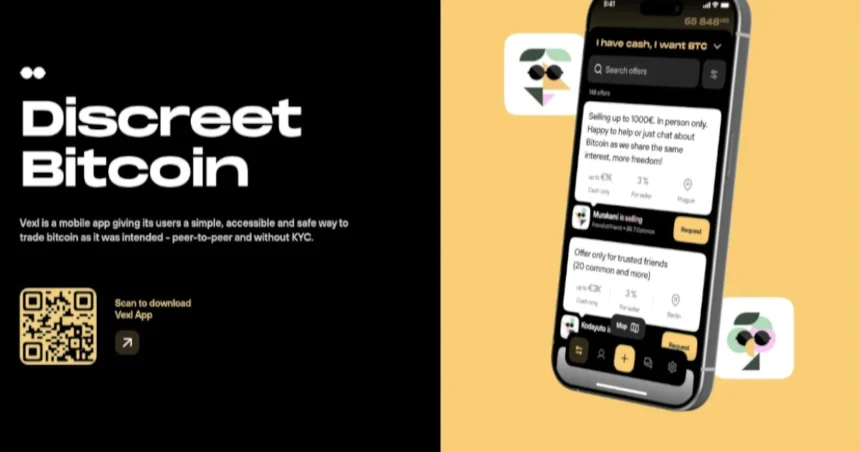
In a landscape dominated by centralized cryptocurrency exchanges, Vexl emerges as a distinct peer-to-peer (P2P) application aimed at facilitating direct Bitcoin transactions among users within their personal networks. This innovative platform allows individuals to buy and sell Bitcoin without intermediaries, placing a significant emphasis on local exchanges and in-person meetings for cash transactions. Additionally, Vexl supports private fiat transfers between users, further enhancing its user-centric approach.
Vexl’s CEO, Viliam Klamarcik, articulated the app’s vision during an interview, stating that it provides a direct trading experience devoid of intermediaries and Know Your Customer (KYC) requirements. “We are basically a peer-to-peer notice board where you can connect with your first and second level degree of connections,” he noted, indicating the platform’s focus on community and trust.
The application prioritizes privacy and operates as a secure notice board, distinguishing itself from conventional exchanges. Vexl does not engage in the escrow of Bitcoin or fiat currency, nor does it store user funds, messages, or personal information. All interactions are conducted via end-to-end encrypted chats, facilitating trades outside the app and placing the onus of counterpart verification on users. This design supports the platform’s commitment to non-KYC Bitcoin acquisition as well as the strengthening of local economies. The app’s official website reinforces this ethos by stating, “We do not store any personal information or any of your messages, period.”
Vexl employs a web-of-trust model for establishing user connections, where phone contacts are imported to create a personalized order book. Offers are only visible to users’ first- and second-degree connections—essentially friends and their network—promoting liquidity while maintaining a high level of trust through established social links. This approach minimizes interactions with unknown individuals, reducing the risk of scams. Additionally, usernames remain anonymous unless mutually disclosed, fostering a safer trading environment. Klamarcik emphasized this aspect, stating, “The biggest difference between Vexl and the other applications is…you trade with people with whom you are connected through real social links.”
To enable the platform’s functionalities, Vexl requires user registration via a phone number, which serves as a proof of identity to counteract bot activity and facilitates contact imports. Privacy is safeguarded through encryption and hashing processes to ensure that contacts remain invisible to anyone, including the platform itself. Acknowledging the potential drawbacks of phone number registrations, Klamarcik emphasized its importance for establishing trust while recognizing that it may not be a perfect solution.
For users who prefer not to fully share their contact lists—especially in regions with strict privacy norms like Germany—Vexl offers “clubs.” These curated groups, moderated by local individuals or meetup organizers, allow members to view offers without extensive network disclosure, though the responsibility of trust is shifted to the moderator. Entry into these clubs requires a one-time code or QR scan, which boosts onboarding for newcomers until they establish direct connections.
The application is available on both Android and iOS, but iOS users face limitations. It is not officially listed on the App Store; instead, it is available only through TestFlight beta slots or sideloading in the EU due to Apple’s reservations regarding in-person trades. In contrast, Android users can access the app directly via Google Play or APK downloads, making it more user-friendly on that platform.
Operating under the Vexl Foundation as a non-profit entity, the app avoids the profit-driven model that could attract regulatory scrutiny, focusing instead on donations and grants to maintain its peer-to-peer spirit. This operational framework is part of a broader trend among Bitcoin privacy tools, where various entities have faced severe consequences for for-profit activities. Recently, founders of the Samourai Wallet received prison sentences for money laundering conspiracy, while Tornado Cash was subjected to U.S. sanctions for its alleged role in facilitating significant money laundering. In light of these developments, many privacy-oriented projects, including Vexl, are adopting non-profit statuses to navigate regulatory landscapes more safely. Vexl is also open-source, developed by Satoshi Labs, known for creating the Trezor hardware wallet.
As for the future, Klamarcik hinted at plans for expansion, expressing optimism about venturing into markets beyond Europe. “This year is hopefully going to be the year when we actually go overseas and also focus on markets outside of Europe when it makes sense,” he stated, indicating Vexl’s ambition to broaden its reach in the ever-evolving cryptocurrency landscape.