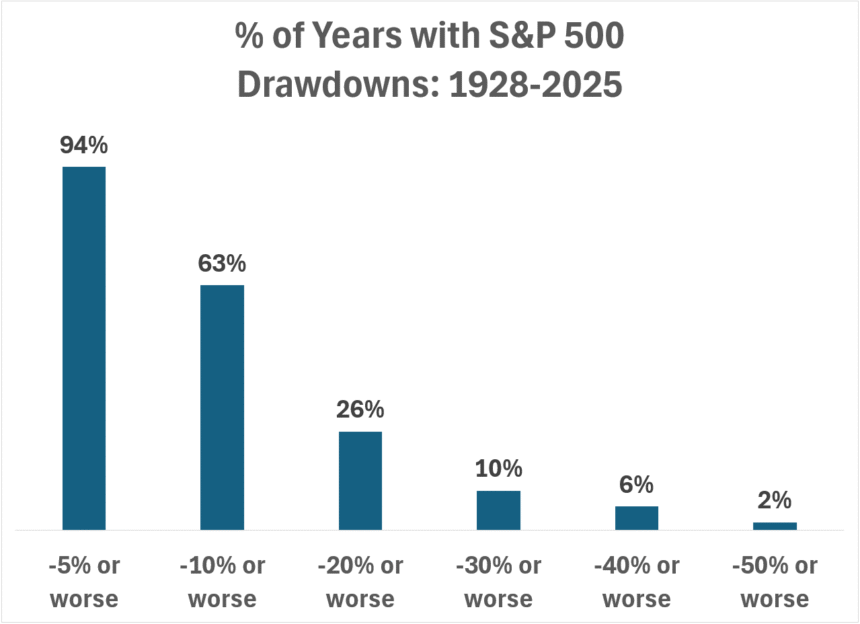
Emphasizing a long-term investment strategy, many experts suggest that engaging with the stock market can yield better outcomes over extended periods. While the potential for gains exists, market volatility represents a significant factor to consider, especially over short durations. Historical data shows that while the S&P 500 has provided substantial long-term growth, fluctuations are not uncommon.
Over the last century, it has been evident that a considerable portion of years experienced notable drawdowns. Specifically, two-thirds of the years saw a peak-to-trough drop of 10% or more, and a staggering 94% experienced at least a 5% correction. Furthermore, approximately one in four years recorded a 20% decline.
Analyzing earlier historical data, particularly from 1928 to 1950, sheds light on the volatility characteristic of that era. Each year experienced at least a 10% correction, and half of those years even faced an intrayear bear market, largely influenced by events such as the Great Depression and World War II.
In stark contrast, the following 75 years, particularly the post-World War II period, present a different picture, providing a more relevant framework for today’s investors. Observers of historical trends suggest that the likelihood of experiencing another catastrophic crash similar to that of 1929 is limited, due to various structural changes in the economy and financial markets.
Nonetheless, the first decade of the 21st century reminded investors of the lurking risks, exemplified by two significant market downturns. Even within the relatively recent 2020s, three bear markets have taken shape, triggered by events such as the COVID-19 pandemic and subsequent market fluctuations.
While examining these long-term averages can offer valuable context, it’s crucial to acknowledge the inherent risks accompanying stock market investments. Ups and downs are a natural part of investment journeys, as historical setbacks are intertwined with long-term gains.
In recent discussions, experts have pondered potential market scenarios for 2026 and beyond, emphasizing the importance of maintaining a perspective grounded in historical performance. Engaging with insightful resources can further enhance investors’ understanding of market dynamics and potential future trends.
Investors are encouraged to seek advice tailored to their circumstances but are reminded that past performance is not a guarantee of future results. The complexities of investing necessitate careful consideration, as risks continue to shape the landscape of financial markets.
For additional insights, subscribing to financial analysis content, such as podcasts and videos focused on investor education, can provide valuable perspectives on navigating market challenges and opportunities.