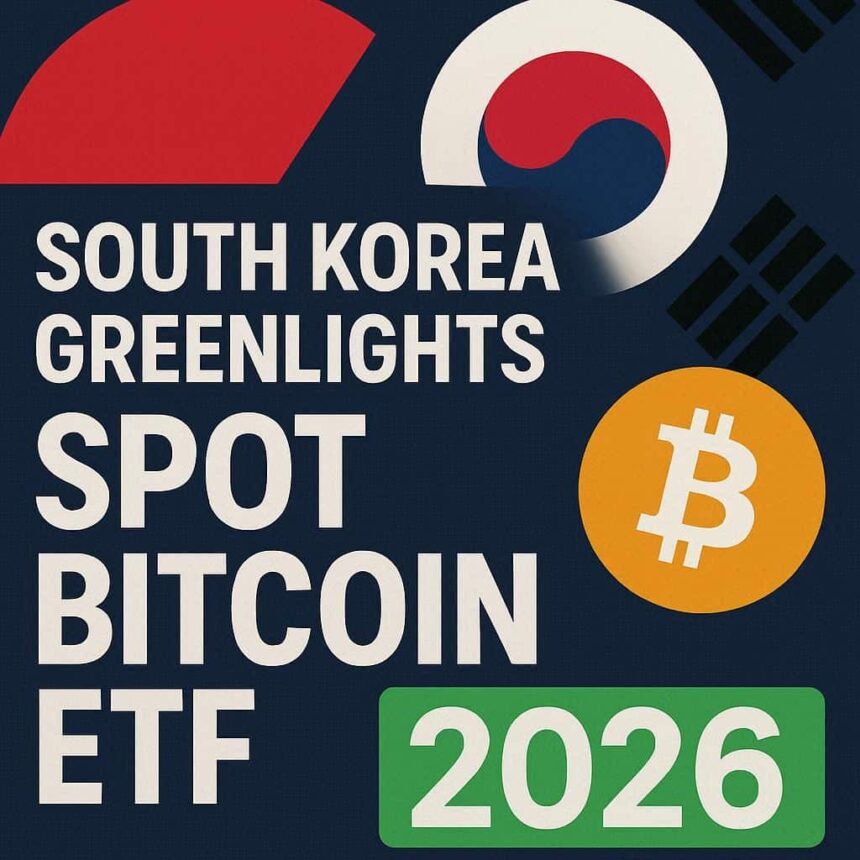
South Korea is making significant strides in its cryptocurrency landscape as part of its ambitious growth strategy for 2026. The government has announced plans to introduce spot Bitcoin and digital asset exchange-traded funds (ETFs) by that year, marking a notable shift in its regulatory approach. This development will allow investors to gain exposure to major cryptocurrencies like Bitcoin and Ethereum through regulated funds, rather than direct exchanges.
The move is tied to a broader digital asset initiative, aiming to establish a comprehensive legal framework, including a new Digital Asset Act that focuses on regulating stablecoins. This marks a significant change from the previous position of the Financial Services Commission (FSC), which warned securities firms against offering access to overseas-listed spot Bitcoin ETFs as recently as January 2024. The FSC indicated that it would continue to monitor global trends while maintaining its stance against such financial products within the domestic market.
In the recently outlined plans, the government aims to complete Phase 2 of its digital-asset legislation by the first quarter of 2026. This phase includes key requirements such as issuer approvals and capital checks, designed to safeguard reserves and improve redemption processes for investors. Officials also noted that these efforts are part of broader market reforms intended to enhance capital access and support cross-border activities.
A separate update from the finance ministry revealed that South Korea would transition to 24-hour foreign exchange (FX) trading starting in July 2026. This shift aims to facilitate smoother trading of the Korean won for global investors, which has historically been hampered by capital controls and trading limits.
Market participants are now closely watching for the potential re-emergence of the “kimchi premium,” a phenomenon characterized by the price difference between cryptocurrencies on Korean exchanges versus international markets. Currently, there is a modest 0.61% premium on Bitcoin prices between the domestic exchange Upbit and Binance, reflecting the ongoing dynamics of demand and trading limits.
However, while the introduction of a spot Bitcoin ETF appears more feasible than before, analysts caution that substantial challenges remain. These challenges include establishing clearer rules for corporate and institutional participation, the governance of benchmark indexes, and ensuring that market makers have adequate tools for risk management and liquidity. Experts note that the successful implementation of spot Bitcoin ETFs will depend on the development of a supportive market structure that currently lacks certain essential participants.
As South Korea progresses toward finalizing its digital asset legislation and other reforms, the next few months will be crucial. Market watchers will be examining three primary signals: the completion of the Phase 2 digital asset legislation, the FSC’s regulations for institutional access and ETF market-making, and the effectiveness of FX market reforms in minimizing historical trading frictions that have contributed to the kimchi premium spikes.