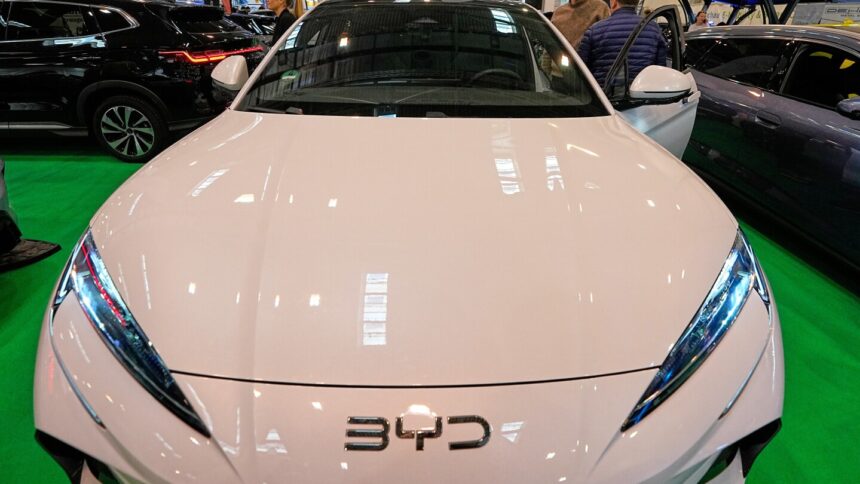
Chinese automakers are significantly expanding their global presence, particularly in the electric vehicle (EV) sector, where they have gained a reputation for producing stylish, tech-savvy, and affordable vehicles. This trend has raised concerns among established manufacturers, especially as Canada recently agreed to reduce its tariffs on Chinese EVs in exchange for concessions regarding Canadian agricultural products. This move could provide Chinese carmakers with enhanced access to the Canadian market, effectively positioning them to become dominant players in the global auto industry as their domestic demand decreases.
U.S. officials have voiced their apprehensions regarding this development. At a recent meeting in Ohio, Transportation Secretary Sean Duffy emphasized the implications of the trade deal, stating, “They want to take over the auto industry. They want to take away these jobs.” He warned that Canada may regret its partnership with China in the automotive sector, pointing to the Chinese Communist Party’s significant investments in their auto industry aimed at establishing dominance.
Experts acknowledge that the rise of Chinese automakers is becoming increasingly unavoidable. Ilaria Mazzocco, a specialist in Chinese Business and Economics at the Center for Strategic and International Studies, highlighted that Chinese brands are gaining popularity not just in niche markets but in more prominent markets that are critical for U.S. manufacturers to maintain their competitive edge.
One of the distinguishing features of Chinese-made vehicles is their combination of affordability and advanced technology. Mazzocco noted that these vehicles often have a competitive price range, costing between $10,000 and $20,000, which is significantly lower than the average cost of new vehicles in the U.S., which hovers around $50,000. Additionally, Chinese automakers excel in producing smaller, lighter vehicles, which are favorable for extending the driving range of electric cars—segments that many American companies have largely abandoned in favor of larger, more profitable SUVs and trucks.
The global push towards electrification presents a pivotal opportunity for Chinese EV manufacturers. According to recent data, the market for plug-in hybrids and electric vehicles in China has grown by 17%, while Europe recorded a 33% increase. In contrast, U.S. sales have seen only a marginal 1% increase, indicating a lag in America’s response to this global shift. This is compounded by a shift in U.S. policy away from ambitious EV strategies, a move that has some experts worried about the future of American automotive manufacturers.
As Chinese companies prepare to enter the Canadian market more readily, they must also comply with standards similar to those in the U.S., which could encourage further investment in Canadian manufacturing. Market analysts predict that by 2030, Chinese brands could capture as much as 30% of the global automotive market. Mark Wakefield of AlixPartners remarked that the success of these brands in European and South American markets has laid the groundwork for their entry into Canada and Mexico, which poses a significant challenge for American automakers.
Countries have been wary of the rapid expansion of Chinese EV manufacturers, citing concerns about competition and technological control. The fear is that granting increased market access to Chinese companies may result in a significant and unregulated presence that could undermine local industries. Other nations, including those within the European Union, have instituted tariffs aimed at curbing the influx of Chinese EVs, although negotiations are ongoing.
The recent tariff reduction in Canada represents a critical juncture in the ongoing discussions regarding the future of the global automotive landscape. Despite regulatory efforts, industry experts assert that the progression of Chinese manufacturers is likely to be unstoppable, indicating a need for protective measures as they enter Western markets. The automotive industry is clearly at a crossroads, with profound implications for the future of manufacturing, jobs, and consumer choice worldwide.