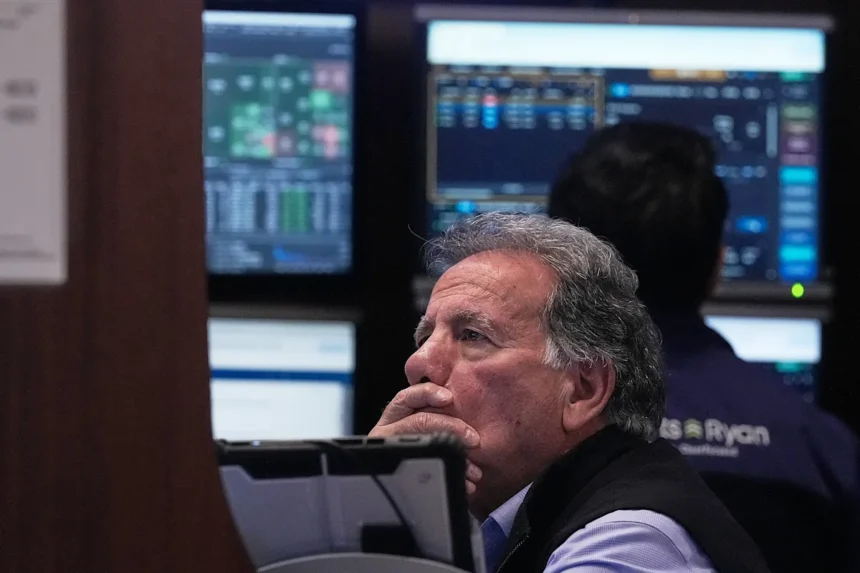
US stocks exhibited little movement on Friday, reflecting a backdrop of mounting uncertainty over the nomination of the next Federal Reserve chair. Despite strong earnings from major banks and ongoing geopolitical issues, the markets maintained a cautious stance.
The Nasdaq Composite dipped slightly, closing below the flat line, while both the S&P 500 and the Dow Jones Industrial Average saw marginal declines, with all three major indices recording losses of less than 1% for the week. However, small-cap stocks broke new ground as the Russell 2000 closed at a record high, marking an 8% gain for the year to date.
Earlier gains in the market were reversed after President Trump expressed hesitation about appointing Kevin Hassett as the next Fed chair. During a White House event, Trump mentioned, “I actually want to keep you where you are,” implying that Hassett might better serve in his current role as director of the National Economic Council. This uncertainty has led to speculation about the central bank’s potential shift from its dovish stance once Jerome Powell’s term ends in May.
Investors on Wall Street had a tumultuous week, complicated by rising tensions with Iran, discussions regarding the acquisition of Greenland, and a criminal investigation into the Federal Reserve’s independence, with all events shadowed by Trump’s influence. As stock and bond markets prepare to close on Monday in observance of Martin Luther King Jr. Day, investors will have an extended weekend to reflect on recent developments.
Chip manufacturers TSMC and Nvidia saw gains, credited in part to a US-Taiwan trade agreement projected to enhance American chip and technology production by $250 billion. TSMC’s stock surged following a robust quarterly report, reinvigorating optimism around AI-related sectors.
Meanwhile, regional banks like PNC and Regions Financial experienced gains aligned with notable quarterly performances from larger financial institutions, including Goldman Sachs and Morgan Stanley, which also reported increased profits.
On the commodities front, silver prices decreased as the announcement of deferred US tariffs eased market pressures; however, silver still accrued substantial weekly gains of over 15% after a significant rally in precious metals.
The week concluded with notable indicators of market sentiment. The small-cap Russell 2000 sustained its momentum, outperforming the S&P 500 for 11 consecutive days, a streak not observed since 2008. The year-to-date performance showcases the Russell’s 8.4% rise compared to the S&P 500’s modest increase of 1.6%.
Analysts at UBS emphasized the ongoing “structural trend of AI” that they believe will drive equities forward in 2026, asserting the importance of investment in AI-linked stocks for long-term wealth growth. Their report indicated that sectors like financials and healthcare are well-positioned for growth due to favorable fundamental factors.
Concerns regarding the job market and potential Federal Reserve rate cuts were also raised, while outlooks for homebuilding remained bleak with a downward shift in builder sentiment linked to affordability issues exacerbating the housing market’s cooling.
In corporate news, Walmart announced significant executive changes ahead of a planned CEO transition, alongside updates from asset manager State Street, which revealed a revenue boost but fell short on earnings projections due to repositioning costs.
As traders wrapped up their week, the sentiment leaned towards cautious optimism with eyes on potential shifts in Federal Reserve policy and ongoing developments in the broader economic landscape.