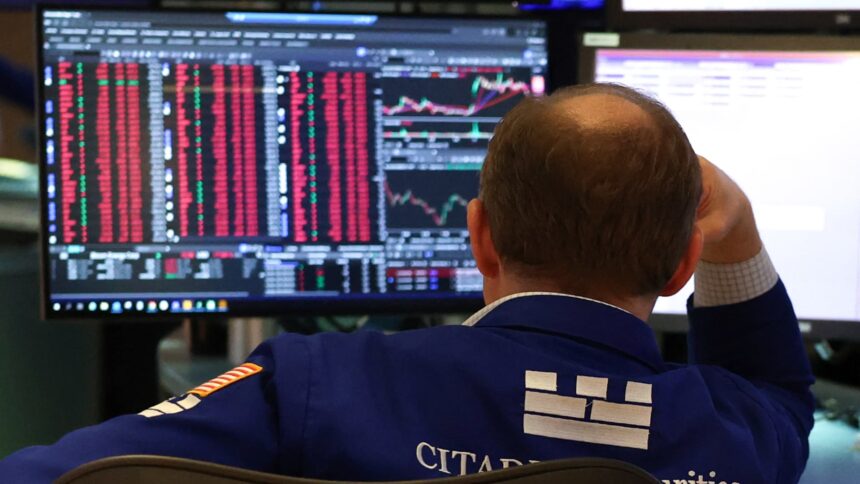
Bank executives urged for measured responses amid a significant decline in stock markets on Tuesday following President Donald Trump’s renewed threats of tariffs. The pan-European Stoxx 600 index fell approximately 1.2% during morning trading, reflecting widespread sell-offs across major European exchanges and sectors, particularly after Trump proposed a potential 200% tariff on French wine and champagne. In the U.S., futures also indicated a downward trend, with the Dow Jones Industrial Average down nearly 1.5%, the S&P 500 declining by 1.6%, and the Nasdaq dropping close to 2%. Asian markets had previously closed in the red, signaling widespread investor concern.
As the World Economic Forum in Davos took center stage, European banking leaders called for composure in light of the looming threat of a renewed trade war, reminiscent of last April’s “Liberation Day” tariff chaos. Bettina Orlopp, CEO of Commerzbank, emphasized the importance of remaining calm and assessing the situation carefully, reminding viewers that last year’s tariff episode taught a valuable lesson in maintaining perspective.
The banking sector faced considerable pressures, with the Stoxx 600 Banks Index showing a decline of around 1.4%, while financial services fell by about 1.3%. This market turbulence follows Trump’s announcement that he intends to impose a 10% tariff on European goods starting February 1, potentially escalating to 25% by June 1 if European nations persist in their opposition to his plans regarding Greenland.
Anthony Gutman, co-CEO of Goldman Sachs International, remarked on the prevailing market noise contributing to increased volatility for investors, suggesting this scenario may become the “new normal.” He expressed optimism about European growth in 2023 but acknowledged that the risks associated with tariffs could complicate decision-making for business leaders.
Steven Van Rijswijk, CEO of ING Group, reflected on last year’s tariff-related turmoil, noting that while European markets had managed to endure the challenges, the weaponization of trade policies has served as a crucial alert for the region. He pointed to the troubling nature of ongoing tariff discussions and geopolitical rhetoric, suggesting they threaten economic stability.
Van Rijswijk emphasized that stability and long-term policies benefit economies and societies, while posing questions about the indirect impacts of such trade disputes. He speculated on possible shifts in trade patterns and investments in response to the current geopolitical climate, highlighting concerns that extend beyond the immediate effects of tariff implementations.
As discussions continue at the Davos summit and the market reacts to the unfolding situation, the focus remains on finding strategic pathways to navigate the complexities introduced by these geopolitical tensions.