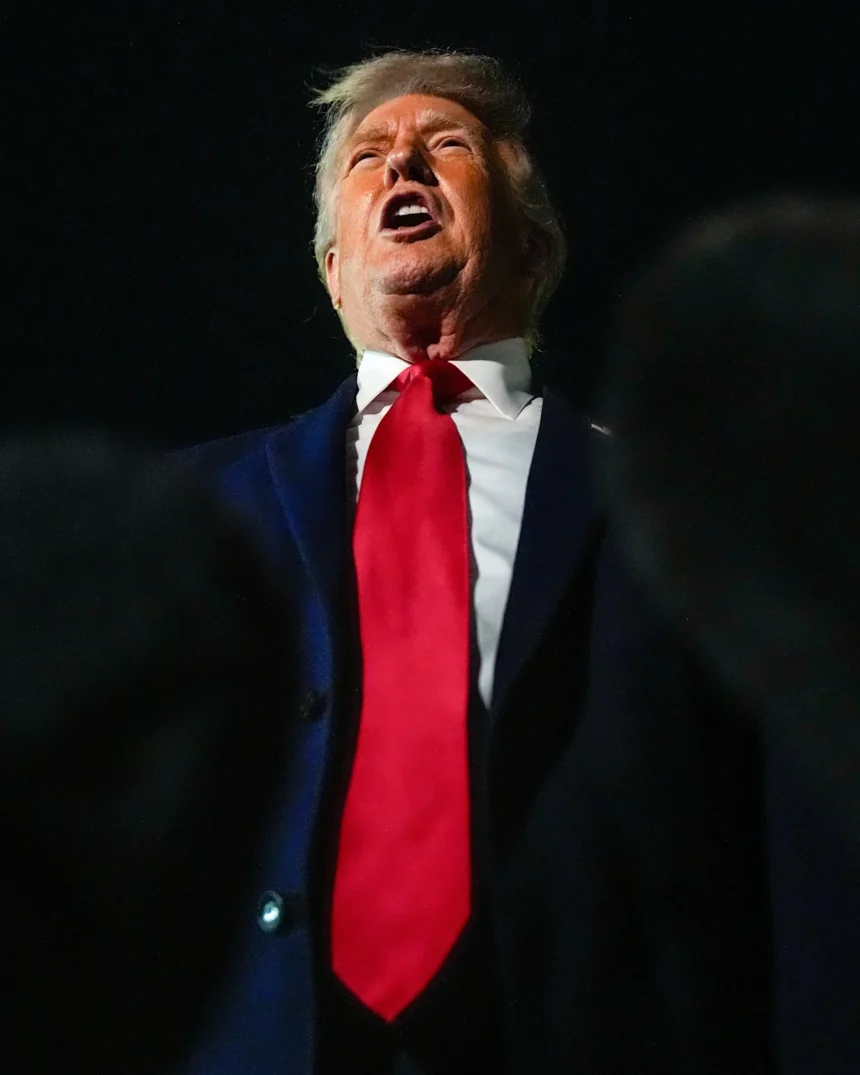
The stock market is currently facing significant turbulence, primarily triggered by renewed concerns over tariffs and trade relations. Investors are grappling with the implications of President Trump’s recent announcements regarding tariffs, which are garnering attention for their potential impact on economic stability.
The Dow Jones Industrial Average, S&P 500, and Nasdaq Composite all experienced substantial declines as trading opened on Tuesday morning, while investors sought refuge in gold—a traditional safe-haven asset during times of uncertainty. The catalyst for this shift can be traced back to Trump’s proclamation over the weekend that the United States would impose a 10% tariff on eight European nations, escalating to 25% by June unless the U.S. secures control of Greenland. This announcement has alarmed key trading partners, including the UK and Germany.
The situation escalated the following day as Trump prepared for his participation in the World Economic Forum in Davos, Switzerland, where he is set to engage with leading business executives. Treasury Secretary Scott Bessent underscored the distinct nature of Trump’s threats regarding Greenland compared to past trade negotiations. He cautioned European nations against retaliatory measures, urging them to adhere to existing trade agreements for greater predictability in market conditions.
Market analysts are interpreting the latest round of tariff discussions as heralding a more prolonged period of uncertainty. Beata Manthey, a Citi strategist, emphasized that the renewed tensions between the U.S. and Europe could undermine investment sentiment towards European stocks, leading to a downgrade for continental Europe to neutral for the first time in over a year. This viewpoint extends to sectors like automotive and chemicals, which are particularly vulnerable to shifts in trade policy.
JPMorgan strategist Greg Fuzesi echoed these sentiments, warning that if the situation regarding Greenland precipitates a broader wave of uncertainty, it could have a significant economic impact.
The current market atmosphere reflects a precarious balance; investors are navigating a resurgence of volatility at a time when they have been heavily invested in high-growth sectors, particularly in technology. Many had believed the market was on a relatively stable trajectory, buoyed by a burgeoning interest in AI-driven companies such as Nvidia, Google, and Microsoft. This most recent disruption has raised alarm bells among analysts, especially given that the volatility index (VIX) has plummeted to an eight-year low, indicating a scarcity of protection against potential market corrections.
Financial data shows that cash levels held by fund managers have reached a record low, even as stock allocations have surged to their highest levels since late 2024. The S&P 500’s forward price-to-earnings ratio stands at 23 times, well above the historical average of 18.7 times, suggesting that stocks are approaching valuation levels seen during previous market peaks.
Strategists are cautioning that if aggressive rhetoric continues, markets could be exposed to more significant fluctuations. The prevailing atmosphere suggests that many investors are ill-equipped for further negative surprises, prompting calls for increased vigilance as developments unfold.