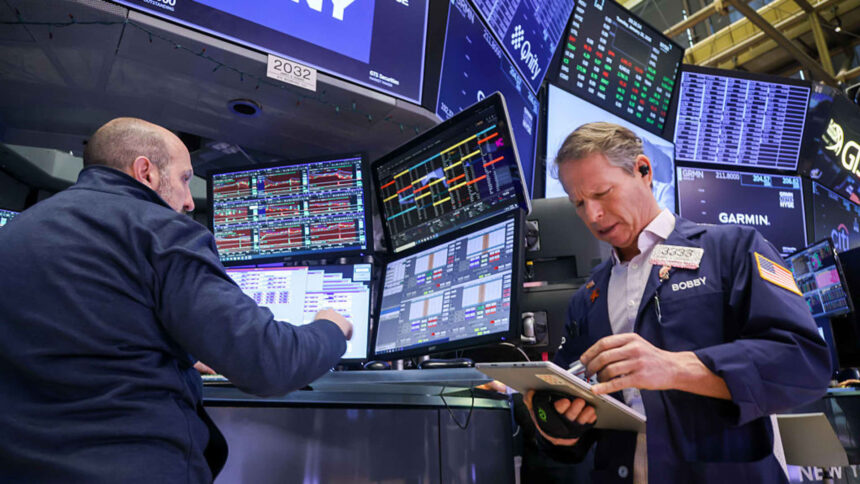
Traders at the New York Stock Exchange faced a turbulent day as stock futures showed signs of optimism Tuesday night, recovering slightly after major averages endured their worst day in three months. Futures linked to the Dow Jones Industrial Average climbed by 85 points, approximately 0.2%. Similarly, S&P 500 futures increased by nearly the same margin, while Nasdaq 100 futures gained 0.1%.
The regular trading session witnessed U.S. equities experiencing significant losses, primarily driven by President Donald Trump’s escalating threats of tariffs regarding Greenland ahead of his upcoming appearance at the World Economic Forum in Davos. The 30-stock Dow retreated more than 870 points, representing a decline of about 1.8%. The S&P 500 recorded a drop of roughly 2.1%, while the tech-heavy Nasdaq Composite fell 2.4%, marking the worst daily performances for all three major indices since October 10. This sharp selloff pushed the S&P 500 and Nasdaq into negative territory for the year, signaling concerns about the longevity of market resilience.
The day’s trading was characterized by what some analysts labeled a “sell America” trade, coinciding with a rise in U.S. Treasury yields and a drop in the U.S. dollar. The yield on the 10-year Treasury note surged and crossed the 4.3% threshold during the session’s peak, an indicator of investor apprehension.
In a concerning development, Trump intensified his rhetoric regarding Greenland by threatening to impose a staggering 200% tariff on French wines and champagne. This reaction reportedly stemmed from a perceived snub by French President Emmanuel Macron, who declined a seat on Trump’s proposed “Board of Peace” on Gaza. Over the weekend, the president revealed plans for escalating tariffs on imports from eight NATO member countries, starting at 10% on February 1 and soaring to 25% by June 1, contingent upon negotiations about purchasing Greenland.
The geopolitical tensions escalated further as Danish pension operator AkademikerPension announced it would divest its $100 million stake in U.S. Treasurys, citing concerns over U.S. fiscal stability. This decision coincided with a broader rise in tensions between the U.S. and Denmark, a situation heightened by Trump’s aggressive stance. In light of Trump’s threats, European leaders have signaled they may resort to counter-tariffs and other economic sanctions against the U.S.
Investment strategist Yung-Yu Ma, in an appearance on CNBC’s “Closing Bell,” noted that while the current pullback isn’t significant, there remains a realistic possibility of further negative shifts in the market, suggesting investors may need to prepare for a challenging landscape.
This week is pivotal for corporate earnings, as market participants hope that forthcoming reports will maintain support for stock valuations. After hours on Tuesday, Netflix shares saw a decline of over 4% following a minor earnings beat for the fourth quarter. Upcoming reports from notable companies, including Johnson & Johnson, Halliburton, and Travelers, are eagerly awaited by investors looking for clues about the market’s trajectory moving forward.