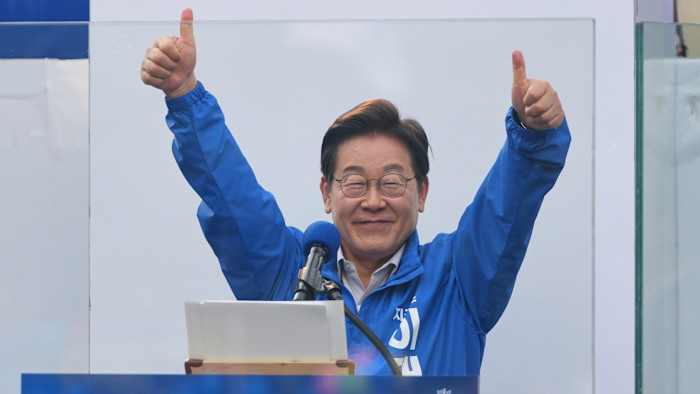
South Korea’s benchmark Kospi index has reached a significant milestone, surpassing the 5,000 mark after witnessing a remarkable nearly 20 percent rise this month. This surge is credited mainly to the thriving semiconductor sector, buoyed by corporate governance reforms initiated by President Lee Jae Myung. The latest increase, noted on Thursday, serves as a considerable boost for the president, who had emphasized the importance of reforms to enhance the attractiveness of investing and had set a target for the index to hit 5,000 during his tenure.
The remarkable rise in the Kospi has been predominantly driven by major chipmakers, including Samsung Electronics and SK Hynix, which capitalized on an AI-driven supercycle in memory chips. Combined, these companies represent over one-third of the entire Korean market. In anticipation of growth, Samsung’s shares have surged nearly threefold in the past year to Won 154,700, while SK Hynix’s stock has skyrocketed almost fourfold, now sitting at Won 766,000.
According to Jonathan Pines, head of Asia ex-Japan at US investment group Federated Hermes, the market’s ascension can also be attributed to the effect of recent corporate governance reforms. Pines remarked, “South Korea has addressed the main reasons for the so-called Korea discount.” He expressed optimism about the market’s momentum, stating, “We believe the rally will continue because the market remains cheap. Stocks are rising for good reasons and news flow remains positive.”
Since assuming office last June, President Lee has focused on addressing the issues underlying the “Korea discount,” which historically hindered stock valuations compared to other markets. A significant revision to the country’s Commercial Act last July has established a legal obligation for directors to prioritize the interests of all shareholders, rather than favoring only the conglomerate’s ruling family members. Additionally, the government is actively promoting tax incentives to encourage higher dividend payouts, which have traditionally lagged behind those of other markets.
Future measures aimed at dismantling the entrenched voting power of dominant family shareholders are also anticipated from the Lee administration. One proposal includes the cancellation of treasury stocks—shares retained by companies—which the government believes would enhance the power of minority shareholders and improve earnings per share.
During his election campaign, President Lee championed the “Kospi 5,000” target, asserting that establishing a fair and effective corporate governance structure would propel the stock market to significant heights. He had previously communicated on social media in April, when the Kospi lingered below 2,500, regarding the potential for stock market advancement.
Despite the recent rally, many South Korean retail investors, often referred to as “ants,” missed the opportunity to capitalize on the rising market. According to data from the Korea Exchange, these domestic investors were net sellers of equities last year. Kim Keum-hee, a freelance photographer from Seoul, expressed regret for not investing in local stocks, particularly stalwarts like Samsung Electronics. However, she remains skeptical about the significance of crossing the 5,000 threshold. “Just because the Kospi breaks 5,000 doesn’t mean the Korean economy is booming,” Kim remarked.
The Bank of Korea reported a contraction of 0.3 percent in the economy during the fourth quarter compared to the previous quarter, although it expanded by 1 percent in the same quarter a year prior. Han Ji-young, an analyst at Kiwoom Securities, noted that there is still potential for the Kospi to grow further, citing reasonable valuations. Upcoming earnings reports from SK Hynix are anticipated to outperform expectations, as highlighted by Ray Wang, an analyst at SemiAnalysis.
Hyundai Motor has joined the market rally, with shares nearly doubling in the past month to Won 587,000. Investor confidence in the company’s advancements in robotics and autonomous vehicle development has been a contributing factor to this surge.