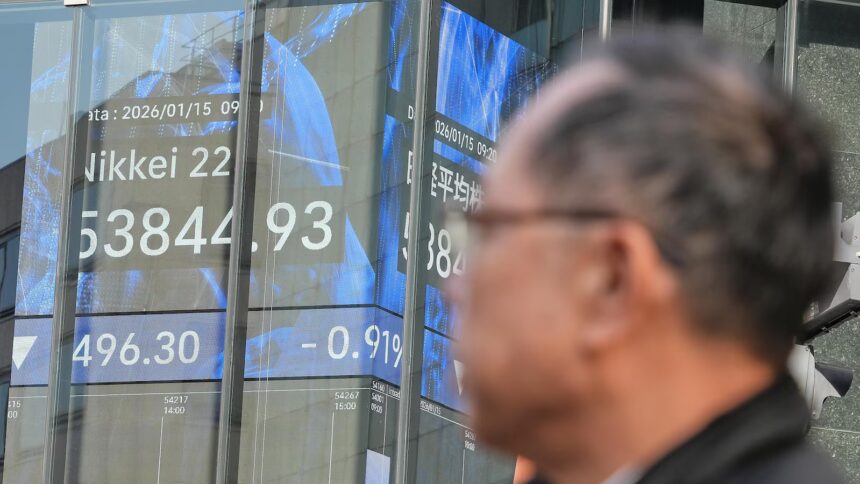
Asian shares and U.S. futures experienced a modest uptick on Friday as markets showed signs of recovery following a turbulent period. Tokyo’s Nikkei 225 advanced by 0.2%, reaching 53,800.28 after the Bank of Japan opted to maintain its key interest rate, aligning with market expectations. This decision follows the central bank’s previous rate increase to 0.75% in December. As part of its policy meeting, the Bank of Japan also slightly revised its forecasts for future inflation and economic growth.
In currency markets, the Japanese yen depreciated against the U.S. dollar, which traded at 158.64 yen, compared to 158.42 yen earlier. Analyst Abhijit Surya from Capital Economics noted that with persistent inflationary pressures, the Bank of Japan may resume tightening monetary policy in the upcoming months.
Chinese markets recorded moderate gains, with Hong Kong’s Hang Seng index rising 0.3% to 26,718.13, while the Shanghai Composite index matched that gain at 4,133.58. In South Korea, the Kospi index climbed 0.6% to 4,983.36, recovering after briefly exceeding the 5,000 mark earlier in the week. Australia’s S&P/ASX 200 gained 0.2% to settle at 8,862.20. Taiwan’s Taiex saw a notable increase of 0.8%, while India’s Sensex remained largely unchanged.
On the U.S. market front, the S&P 500 rose 0.5% to 6,913.35, bolstered by President Donald Trump’s announcement that he was rescinding tariffs on European countries over an ongoing dispute regarding U.S. control of Greenland. The Dow Jones Industrial Average increased by 0.6% to 49,384.01, and the Nasdaq composite soared 0.9% to 23,436.02. However, uncertainties lingers regarding the Greenland deal as it has yet to be formally signed, leaving investors cautious.
The volatility in U.S. stock markets earlier in the week saw a significant drop, marking the worst decline since October. This instigated Trump’s acknowledgment of the downward trend, a deviation from his usual practice of taking credit for successful market performances. The market’s response has contributed to the emergence of the “TACO” acronym, indicating that “Trump Always Chickens Out” in the face of strong market reactions.
In related news, JPMorgan Chase shares ticked up by 0.5% following a lawsuit filed by Trump against the bank, regarding claims that the closure of his accounts was politically motivated after his presidency ended in 2021.
Meanwhile, U.S. Treasury yields remained stable, suggesting that foreign investors maintained their positions within the U.S. bond market. Economic reports indicating better-than-expected strength in the U.S. economy lent some support to yields. Significantly, a report highlighted that fewer workers applied for unemployment benefits than anticipated, while others detailed a more robust economic growth rate over the summer and consumer spending that has somewhat exceeded expectations.
Pressures in global markets may be easing, particularly after long-term Japanese government bonds, which surged earlier in the week due to concerns over governmental debt, saw a retraction. The yield on 40-year bonds, which had recently spiked, declined to 3.0955% Friday morning.
In commodities, gold prices experienced a 0.8% increase, remaining close to the $5,000 mark, while silver surged by 2.3%. Investment in precious metals often rises during periods of market uncertainty as investors seek safer assets. Additionally, U.S. benchmark crude oil prices increased by 52 cents, reaching $59.88 per barrel, while Brent crude improved by 54 cents to $64.60 per barrel. The euro was slightly lower against the dollar, trading at $1.1750, down from $1.1755.