Michael Saylor’s Bitcoin-focused enterprise, Strategy Inc., is now vying to join the ranks of the S&P 500, a prospect that seemed nearly impossible just a year ago. The recent financial performance of the software firm has turned heads on Wall Street, particularly following an impressive $14 billion unrealized gain reported last quarter. This remarkable gain has positioned Strategy as a theoretical candidate for the index, given it meets the profitability requirements under current eligibility rules.
While the journey to S&P 500 inclusion remains uncertain, the repercussions of such an admission could be significant. If Strategy were to gain entry, passive funds linked to the index would need to acquire nearly 50 million shares, translating to an estimated $16 billion based on current valuations. For Saylor, this achievement would serve as institutional endorsement of a corporate strategy that has often been labeled reckless by critics, simultaneously converting entities like pension funds into indirect holders of cryptocurrency.
However, gaining entrance to the S&P 500 is no straightforward endeavor. The committee responsible for the index evaluates liquidity, profitability, and trading history, along with exercising discretion for sector balance. Eligible firms must have a market capitalization of at least $22.7 billion and demonstrate positive income for both the latest quarter and the previous four quarters.
Notably, Strategy has excelled in these parameters, boasting the highest float-adjusted liquidity ratio among a field of 26 candidates identified for this round of index reevaluation, which also includes companies like AppLovin Corp. and Robinhood Markets Inc. This strong liquidity indicates that Strategy trades actively relative to its market size.
The tech-heavy S&P 500 has already begun to embrace the burgeoning cryptocurrency sector, evident from the recent inclusion of Coinbase Global Inc. and Jack Dorsey’s fintech firm, Block Inc. This shift signifies the committee’s interest in expanding representation for key players in the digital asset realm. As noted by Melissa Roberts, a managing director at Stephens, the inclusion of these firms underscores the committee’s commitment to reflecting leading companies within the index.
Despite his firm’s progress, Saylor has faced mounting skepticism surrounding the sustainability of his corporate treasury model, which involves raising capital through debt and equity to invest in Bitcoin. This approach has resulted in periods of intense volatility for Strategy’s stock. The firm experienced a 17% drop in its shares in August, which diminished some of the premium historically associated with its Bitcoin assets. Furthermore, Saylor’s recent attempts to raise capital through preferred stock offerings fell short of expectations, leading to a return to common share issuance that unsettled investors.
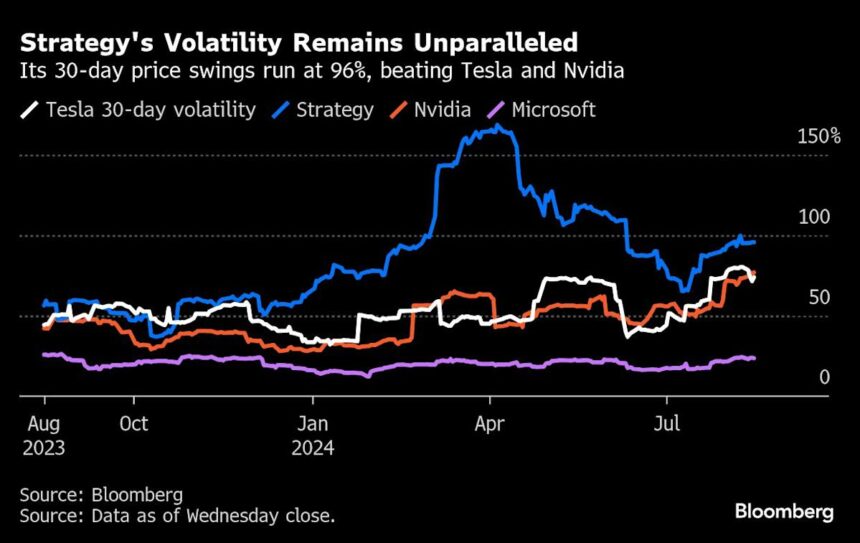
The volatile nature of Strategy’s stock has also raised concerns. With 30-day price fluctuations exceeding 96%, far surpassing those of Nvidia and Tesla, this instability could cause apprehension among those responsible for maintaining the index’s integrity. Recent examples indicate that hype around potential index entry can be misleading; Robinhood saw its stock soar on speculation of inclusion before subsequently falling when the speculation proved baseless.
Despite Strategy’s earlier acceptance into the tech-heavy Nasdaq 100, the S&P 500 represents a more substantial opportunity, with nearly double the asset size and around $10 trillion in passive funds associated with it. Saylor has himself speculated that 2025 could be the year for S&P inclusion.
Typically, entry into the index often prompts a price increase—referred to as the “index effect.” Historical analysis indicates that stocks generally rise upon inclusion though the short-term influence has lessened in recent years. This is partly due to more investors attempting to predict index changes ahead of time, leading to a gradual price adjustment. From a long-term perspective, the increasing prevalence of indexing only adds to the potential for upward price movement.
Edward Yoon from Macquarie Capital emphasizes that Strategy’s substantial $90 billion market cap positions it favorably based on size alone. Nevertheless, the S&P committee must carefully consider sector balance to prevent over-concentration in any one area. Predicting the committee’s decisions remains challenging, as they retain discretion over inclusion, making the path to the index unpredictable.