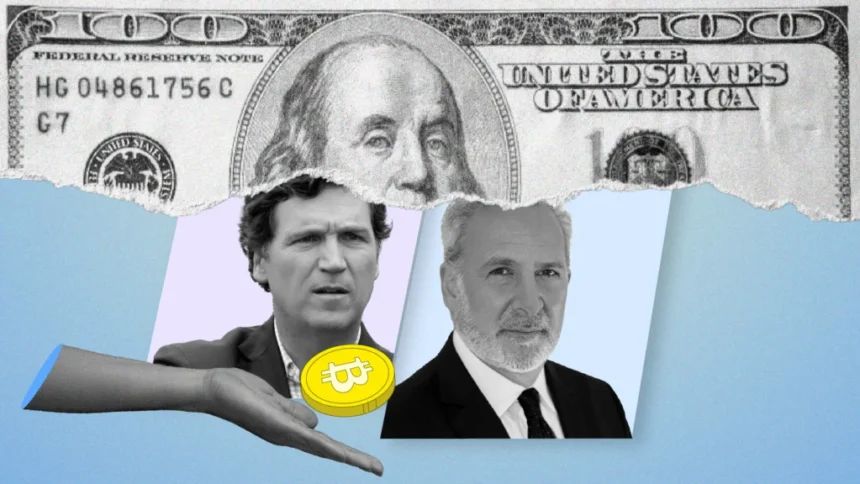
In a recent interview, media personality Tucker Carlson expressed that the diminishing purchasing power of the U.S. dollar could necessitate a new global reserve currency, advocating for Bitcoin (BTC) or Tether (USDT) as potential candidates. This exchange took place during a discussion with renowned economist and gold advocate Peter Schiff, who has long been critical of cryptocurrencies.
Carlson pointed out that the weakening status of the dollar highlights the need for an alternative reserve currency. He argued, “It’s diminishing purchasing power,” and questioned why Bitcoin or Tether couldn’t fulfill that role. These remarks came in response to Schiff’s earlier warnings about the dollar’s erosion, where he stated that the U.S. economy is struggling despite claims of strength from political figures.
Their conversation soon turned to the comparison of cryptocurrencies with gold, a commodity Schiff continues to champion. Carlson highlighted the opportunities around crypto, noting that many individuals have amassed significant wealth through digital assets. Schiff, however, disagreed, asserting that gains in crypto do not stem from productive economic activities, indicating that crypto wealth is often anchored in speculative trading rather than value creation.
Responding to Schiff’s skepticism, Carlson challenged him on the nature of gold investment. He remarked that buying gold, while it can be profitable, does not contribute to economic production. This argument fueled a back-and-forth debate on the merits of both assets. Schiff defended gold, but Carlson maintained that both gold and cryptocurrencies can be seen as speculative, raising questions about their respective values in contributing to the economy.
As this debate unfolded, Schiff reiterated his bleak outlook for both U.S. dollar-denominated assets and cryptocurrencies, predicting significant losses for holders by year’s end. He contrasted this with the potential for wealth accumulation in non-dollar-denominated assets and precious metals.
This cautious perspective on cryptocurrencies is echoed by several high-profile critics. Notable economist Steve Hanke reinforced his belief that Bitcoin possesses “zero fundamental value,” while investor Michael Burry labeled Bitcoin’s push towards six-figure valuations as a speculative bubble, going so far as to compare it to tulip mania.
The dialogue between Carlson and Schiff underscores a growing rift over the future of money, cryptocurrency, and traditional assets, as varying viewpoints emerge on the sustainability and viability of both gold and digital currencies. As skepticism looms over Bitcoin and the broader crypto market, the debate on what constitutes value in today’s economy continues to intensify.