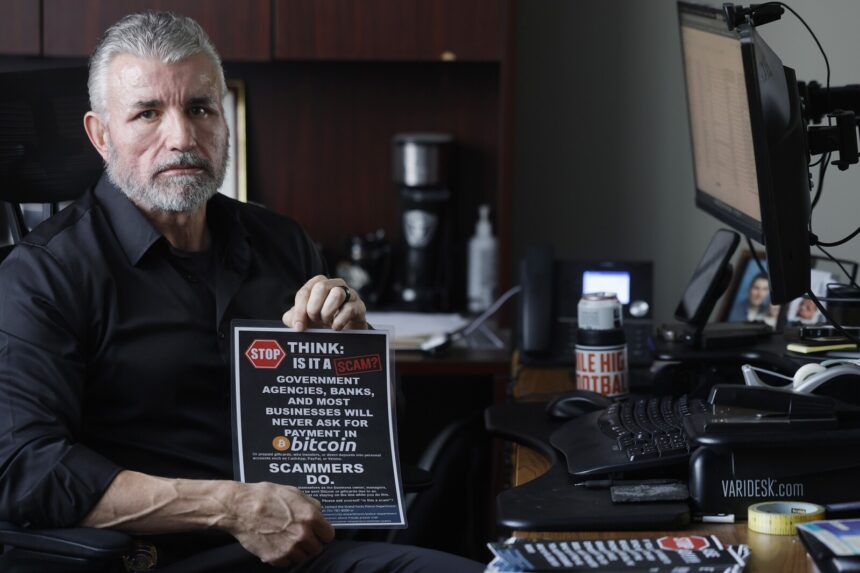
Residents of Grand Forks are being urged to exercise caution when engaging with individuals online, especially if asked to transfer payments via gift cards or Bitcoin. Detective Todd Riedinger has emphasized that requests for payment in these forms are often indicative of scams. He encourages individuals to approach such communications with skepticism, asserting that the assumption should be that it could be a scam until proven otherwise.
During a recent Grand Forks City Council meeting, Riedinger, serving as a financial crimes investigator, highlighted the seriousness of the situation. Since October 2022, residents have reported losses totaling $466,803 due to Bitcoin cryptocurrency scams. This figure rose to $474,803 within a week after the council meeting, although law enforcement managed to reverse a $2,000 transaction.
Riedinger explained that retrieving money lost in these scams is extremely challenging, mainly because the funds are often funneled through various Bitcoin accounts, making them difficult to trace. Scammers typically direct victims to deposit cash into Bitcoin ATMs located in local businesses, where the accounts used are often anonymous. Once the money is converted to Bitcoin and transferred, tracking the funds becomes nearly impossible. Law enforcement usually only becomes aware of such crimes after significant losses have occurred.
In a recent case, a 71-year-old victim nearly fell prey to a scam that could have cost him $20,000. He was misled into believing his bank was stealing from him, prompting him to withdraw his money and convert it into Bitcoin. Fortunately, an employee at a local business housing a Bitcoin ATM notified the police after noticing the man’s unusual behavior, which allowed officers to intervene and prevent the scam.
To combat this growing issue, North Dakota implemented legislation in 2025 that caps daily transactions at Bitcoin ATMs to $2,000. Riedinger believes that this measure has helped but acknowledges that scammers have adapted to these restrictions. He advocates for additional measures, such as requiring ID scans at Bitcoin ATMs to verify account ownership, which could help prevent larger losses.
Riedinger hopes to see more legislation passed in 2027 to close existing loopholes in funding transfers, and he encourages community members to share their experiences and knowledge regarding these scams. He has also extended an invitation to local business owners to discuss Bitcoin ATM operations.
Scammers frequently employ fear tactics to manipulate victims into acting quickly, with some victims reporting threats regarding nonexistent legal issues, like failing to appear for jury duty. Riedinger explained that many victims recognized warning signs during the scams but were overtaken by a sense of urgency instilled by the scammer.
The detective pointed out that gift card scams operate on similar principles, as they are also difficult to trace. Scammers often target the elderly, who may have substantial savings and a tendency to trust others. Riedinger remarked that these criminals exploit the remaining faith people have in humanity, taking advantage of those who are more vulnerable.