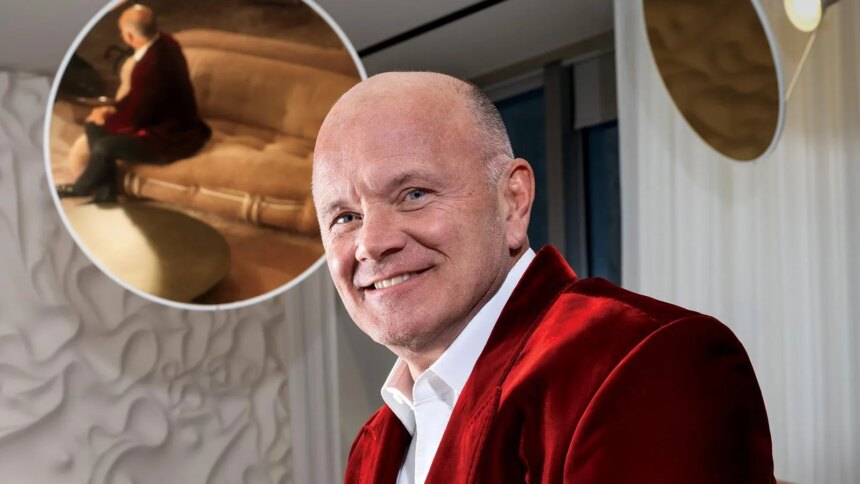
Chaos creates opportunity, a concept that few grasp in the moment and even fewer act upon with significant investments. Former Goldman Sachs trader Michael Novogratz, however, recognized the potential in the midst of turmoil. In December 2022, as the crypto world reeled from the collapse of Sam Bankman-Fried’s FTX empire, Novogratz’s company, Galaxy Digital, made a bold move by investing $65 million in a 160-acre bitcoin mining operation in Dickens County, Texas. At the time, he believed this would be one of his best investments, though he had yet to fully understand its significance.
The backdrop of this decision was stark: the crypto industry was mired in crises, with over $1.5 trillion in digital assets lost that year. Bitcoin and ether prices plummeted by more than 60%, and signs of distress were rampant. As Galaxy’s president Christopher Ferraro noted, the firm had grown anxious about substantial investments tied up in third-party data centers as the financial health of involved parties deteriorated.
Argo Blockchain, the seller of the Helios site, provided Galaxy with a critical asset—land boasting inexpensive power and a nearby labor pool. The transaction was complex, blending aspects of a bailout, legal maneuvering, and creative financing, all intended to preserve Argo long enough to finalize the deal. Initially viewed as a hedge against the chaos, it would take time for Novogratz to realize the true potential of the asset they acquired.
By late 2023, with bitcoin prices hovering around $38,000—40% lower than their highs—Novogratz began to reconsider whether mining bitcoin was indeed the optimal use of Helios. A pivotal conversation on a flight with Christopher James, founder of Engine No. 1, opened his eyes to a broader trend: the looming power shortage tied to artificial intelligence rather than cryptocurrency.
In June 2024, recognizing the shifting landscape, Core Scientific announced a groundbreaking 12-year, $3.5 billion lease with CoreWeave, an AI infrastructure powerhouse. Suddenly, crypto mining was transformed from a perceived dead market to a valuable source of power infrastructure with long-term revenue potential. Quick to adapt, Novogratz solidified an agreement with CoreWeave for a 15-year lease covering 25% of Helios’ 800-megawatt capacity.
The partnership quickly evolved, with CoreWeave committing to lease 100% of Helios’ capacity. Approval from Texas’ ERCOT enables Helios to expand to a remarkable 1.6 gigawatts, positioning it as one of the largest independent data center facilities in the U.S. Anticipated revenues from CoreWeave could surpass $1 billion annually come summer.
Beneath these successes lies Novogratz’s storied career, characterized by resilience similar to the sport of wrestling he excelled at during his youth. A Princeton graduate and veteran of Goldman Sachs, Novogratz experienced both significant triumphs and challenging setbacks, including the 2008 financial crisis that tested his hedge fund.
In 2018, he founded Galaxy Digital with high aspirations of mirroring Goldman Sachs in the crypto world. The firm’s adaptability has proved advantageous, especially following the collapse of FTX. By April 2024, Galaxy secured a $620 million fund, acquiring undervalued assets and emerging as one of the largest crypto lenders alongside Tether and Ledn.
Recent regulatory movements could further amplify Galaxy’s foothold in both the crypto space and the AI-driven data center market, resulting in substantial asset growth—currently reported at around $17 billion. The company’s accomplishments culminated in a record year of profits, evidenced by a net profit of $505 million in the third quarter.
However, navigating both the crypto and data center sectors presents unique challenges. There is contemplation of a potential company split if the complexities of the dual narrative create confusion in public markets. As Galaxy grows, the expectation is that clarity will become essential.
Despite the significant progress, Novogratz is aware of the industry’s need for transformation. He envisions crypto not merely as an investment vehicle but as integral to modern financial infrastructure. The goal is clear: if crypto cannot integrate into daily life—facilitating transactions from buying tickets to managing investments—it will signify a failure of the industry’s vision, regardless of profitability.
The Helios investment, particularly its strategic location within a Qualified Opportunity Zone, highlights its potential value beyond mere crypto operations, with analysts predicting it could outstrip Galaxy’s current market valuation significantly. As both sectors evolve, the future may see either the preservation of Galaxy’s dual focus or a pronounced separation, depending on market developments.